Showing posts with label Jewish writers. Show all posts

Friday, 25 February 2022

Notes from the Holocaust

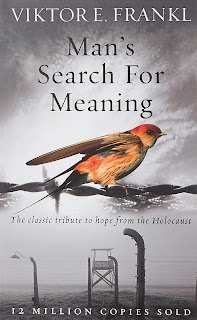
Viktor Frankl (2008), Man’s search for meaning, Rider, London, pp. 154

I read this classic book and ended the last year on a thoughtful note. As December sets in, something tugs me to ponder over the year gone by and my reading list reflects the search for meaning and purpose and a propensity for introspection and reflection. I had saved up this book for the last and as the winter gently rolled in, I was with this exceptional individual, who when faced with unspeakable experiences of adversity, oriented himself towards life and humanity. As I read through Viktor Frankl’s notes from concentration camps during the second world war, there were two people narrating the story. The first was the professor of neurology and psychiatry who spoke with lucid objectivity and dispassionate clarity on what made the survivors last in the midst of horror and incertitude. The second was the individual who reminisced about the life he lost and thought about the life that awaited him with hope and longing. The extraordinary scholar and the ordinary person and the contradiction of the nature and tone of the arguments are some of the things that makes this work a compelling read.

The book is divided into three parts – the experiences at the concentration camp, the introduction to a school of psychotherapy based on these experiences and a post script. The first part reads like a memoir, the second an exposition, and third a thoughtful reflection that asks a few questions.

We live at a time when history is actively being forgotten or misconstrued and the assault on truth and memory is gaining traction as this The New York Times review of books Erasing the Holocaust trenchantly argues.  It is important to lean on memoirs and other forms of historical records to remind ourselves what we have been through and educate ourselves about the consequences of erasure. Beyond the inspiring cadence of the triumph of the human spirit, that is what this book serves to remind us.  

Friday, 1 June 2018

Adieu, Philip Roth


Philip Milton Roth wrote an impressively long list of savagely funny novels and stories during his lifetime including the stunning American Trilogy written in his sixties. He was awarded a number of prestigious literary awards including National Book Award and The Presidential medal for the Humanities during his lifetime. When he died on 22 May, we lost a voice that relentlessly pilloried our absurdities and exposed our fragility. What does Philip Roth mean in a world where Philip Roth does not physically exist anymore?

Guilt as Comedy
Roth followed in the tradition of engaging with guilt-ridden characters after the tradition of Shakespeare’s Othello, Tolstoy’s Anna Karenina, Dostoevsky’s Rodion Raskolnikov, Flaubert’s Emma Bovary and Kafka’s Josef K. But he treated guilt as a comical idea by means of characters who were cut off from their moorings and lived beyond their moral means. His outlandish protagonists were not paradigms of conflicting selves but individuals whose spiritual and sensual ambitions were so inextricably interlinked that they had to find a personalized way of salvation. Their problem was not that they were fragmented and deluded, but that they were whole and undeluded. This often brought them into tension with moral authority and social restraints from the outside. A Rothsian character had moral sovereignty, personal commandments, ethical convictions, personal inhibitions and fear. Her comic recklessness to rebel against taboos brought her pain, rage and a sense of loss and nostalgia as much as honoring social expectations did. Alex in Portnoy’s Complaint and Lucy in When She was Good, rebelling against their parents find their rage inadequate to salvage their pain.

Guilt as comedy was the central preoccupation of Roth as he attempted to portray the vicissitudes of being American and being Jewish. On writing American novels, he described that to understand, describe and make credible the American reality of the twentieth century was a formidable challenge to any writer. He remarked that the American reality ‘stupefies, sickens, infuriates and then embarrasses’ the quintessential American writer because actuality outdoes imagination and life emerges as a substitute for fiction. We experience the outlandishness of this reality in his political satires especially The Great American Novel and Our Gang. The creation of counter history and counter mythology of a nation begins with inane acts of separating the power-holder from power. Roth savagely attacked this discrepancy between official piety and unpleasant truths.

When he started out describing Jewish characters in stories such as Epstein, he was initially described as a self-hating Jew. Quite characteristically, he reacted with ‘to ask a satirist to be in good taste is like asking a love poet to be less personal’. Roth explained that he was trying to not depict a stereotype of the Jew but point out when a Jew acted like the stereotype. He was responding to the Jewish predicament of the need to act out Jewishness in highly differentiated ways which was traumatic and inescapable after having gone through specific kinds of historical persecution and humiliation. His unique position as a Jewish man gave him the freedom to refuse ennobling even the persecuted, with the explanation that the lack of will and grace is found in all of us.

The Final Literary Act
It was this continuing distrust of ‘positions of authority’ including his own that motivated him to write the way he did. He described his writing as a literary act not a political one and his retribution was parodic justice. On this issue, he followed the dictum of the Russian writer Andrei Sinyavsky, whose last statement in his trial by an authoritarian regime was that ‘the most rudimentary thing about literature…is that words are not deeds’.

Roth never wrote for an audience. His deep mistrust of external authority of any kind and validated positions meant that he would not have cared about his legacy as a writer. But he would have cared about being read. It would have mattered to him if his books began conversations between partially realized narratives that we all are, drawing energy from one another. In that sense he has left us a world to continue those conversations. Roth once spoke about the legacy of the writers he admired thus, ‘the trick apparently is to turn yourself from a proper noun to an adjective and the best way to accomplish this is to die’. Now that he is gone, his final literary act has been to gift us this adjective- enter the Rothsian!