Friday, 25 February 2022

Notes from the Holocaust

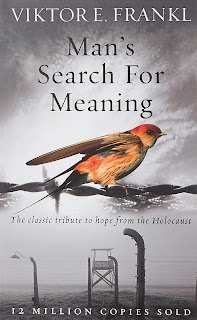
Viktor Frankl (2008), Man’s search for meaning, Rider, London, pp. 154

I read this classic book and ended the last year on a thoughtful note. As December sets in, something tugs me to ponder over the year gone by and my reading list reflects the search for meaning and purpose and a propensity for introspection and reflection. I had saved up this book for the last and as the winter gently rolled in, I was with this exceptional individual, who when faced with unspeakable experiences of adversity, oriented himself towards life and humanity. As I read through Viktor Frankl’s notes from concentration camps during the second world war, there were two people narrating the story. The first was the professor of neurology and psychiatry who spoke with lucid objectivity and dispassionate clarity on what made the survivors last in the midst of horror and incertitude. The second was the individual who reminisced about the life he lost and thought about the life that awaited him with hope and longing. The extraordinary scholar and the ordinary person and the contradiction of the nature and tone of the arguments are some of the things that makes this work a compelling read.

The book is divided into three parts – the experiences at the concentration camp, the introduction to a school of psychotherapy based on these experiences and a post script. The first part reads like a memoir, the second an exposition, and third a thoughtful reflection that asks a few questions.

We live at a time when history is actively being forgotten or misconstrued and the assault on truth and memory is gaining traction as this The New York Times review of books Erasing the Holocaust trenchantly argues.  It is important to lean on memoirs and other forms of historical records to remind ourselves what we have been through and educate ourselves about the consequences of erasure. Beyond the inspiring cadence of the triumph of the human spirit, that is what this book serves to remind us.  

Wednesday, 12 January 2022

Love in the time of AI


 Kazuo Ishiguro (2021), Klara and the Sun, Faber, London, pp.307

It is a brand-new year and I am beginning with one of my favorite writers of all time – the elegant and masterful Kazuo Ishiguro. The blurb of his most recent book Klara and the Sun spoke about robots and my inner voice screamed ‘please don’t go to the other side’. Ishiguro is one of the four authors (others being Alice Munro, Julian Barnes and Penelope Fitzgerald) that I never want to deviate from the path they tread. The day they go uncharacteristic will be the beginning of the end for me. In a world where most things are so irreversibly mutating, I have a terrible propensity for stability and consistency. These authors remain my anchor points for the world as I know it.

Dreading the worst, I bravely began this beautiful story set some time in the future in which children are genetically modified and have robots with artificial intelligence for companions. I mused, ‘clearly, the worst has already happened’! But then, something emerged slowly from the ruins of this dystopian setting, something akin to what you felt when you were reading The Remains of the Day. A master at work on something delicate and undestroyed – the primal innocence we are born with. This is Klara’s reckoning in the human world and she blooms not as AI, but as a child, asking questions, always being curious, and heartbreakingly human. Before long, we are rooting for her as she navigates the politics and platitudes of the society in which she is planted in.

The most beautiful part of the book is the relationship Klara has with the sun. It is one of the oldest tropes of nourishment and life and it symbolizes something undying and irreplaceable in us. It is our capacity to love someone and act on that love. Klara’s love for the child she accompanies is more poignant in the milieu that it is set against, that of a withering human world. And what happens to this person as she unfolds human-like in an inhuman world forms the rest of the story.

It takes mastery to weave the old with the new, retaining something unexpected from both. Ishiguro weaves a rich tapestry not with grandiose strokes, but with fragile imperceptible ones that paint pathos, innocence and first learning, that of children awakening to love and loss with unfailing dexterity. By extracting the human essence out of humanity, he shows the most enduring part of us that are yet savable and worthy of saving.

If this is not a great way to begin this year, I don’t know what is. Here’s wishing you a beautiful year ahead with books!


Wednesday, 10 November 2021

12 women, 200 years


Bernardine Evaristo (2019), Girl, Woman, Other, Penguin books, pp.453


The book came to me as a gift, literally,

a discerning friend’s nod for my love of the literary.

I am glad this book and this author found me

they way they did,

when I was least expecting.

That’s when you are the most vulnerable

and completely open,

an attitude best suited to read

something so expansive as this novel,

the story and history of twelve women

through two centuries across many continents,

told in a compelling contemporary way.


Bernardine Evaristo,

writer, poet, playwright, professor,

the first black woman to win the Booker Prize

an accolade she shared with another great writer,

is a gifted story teller.

As you read through the novel

this aural quality pervades,

the prose is poetic and musical,

evocative and vivid.

So, you picture the protagonists and the places

and hear them speak and think,

walk through the gullies of your mind,

sashaying and shushing,

as they erupt into thoughts and doubts.


It is a tour de force of human history

in the last two centuries,

colonialism, slavery, racism, casteism,

sexism, queerphobia,

all roads taken

to be the human race we are today,

 explored within the microcosm

of individual lives,

specific plots and timelines.


And yet they interrupt each other,

invade and interact with one another

to give the map of a gnarly tree, the pedigree,

from which, these unlikely compatriots

hang like irreverent fruits.

They are ancestors and descendants,

peers and sisters,

exploring and bickering their way

through history and their stories.


Girl, Woman, Other has

the themes and temperaments

that Evaristo’s works tend to have,

 an evaluative perspective of received wisdom

from as many angles as possible,

and a lyrical quality to radical thoughts.


As winter buries us with an impossible longing

for a year that is fast slipping by,

this is the perfect companion

to soothe and comfort you,

enlighten and frighten you,

but above all give you so many opportunities

to live out the lives of others

however imaginary.

That’s what all good writers do.


Saturday, 7 August 2021

Irish Love


Sally Rooney (2018), Normal People, Faber and Faber, London, pp. 266

This is the book you should take with you in summer to remember what it feels like to read a great love story. It is small town Ireland and two young people are in love as they move from high school through college and are just about to begin life. It is that time of life when it is perhaps the most awkward to write about love without sounding flippant or pedantic. It is difficult to speak of love that is so young and unsure, yet when done right it is the kind of quiet love that makes you yearn for good literature.

Sally Rooney does it right. Not just in the convincing way she portrays the protagonists, but also scooping up the sounds and smells of the small town, the flavor of its people, the tone and tenor of high school in the backwater stillness of the place, its intimacies and resentments. The book brings to life those who have adapted themselves for life in a quiet town that the world does not come to. It requires skill and an astute mindset to stay full of life and happy in any place, but more so in a quaint little space dancing to its own tune. The town is abuzz with news - rumours, love affairs, desertion, quiet suicide, seething anger and the whole melodrama that makes life. And amidst this are two people, vulnerable in their lack of self - consciousness, who manage to escape that world without meaning to, and stay connected with each other.

I admit it is difficult to write about it than read and enjoy it. Grab a copy and have a lovely summer! There is an adaptation streaming on Prime, but you are not going to, are you?

Saturday, 31 July 2021

Intimations


Zadie Smith (2020), Intimations, Penguin Books, pp. 82

We all need the quiet homecoming of the literary kind, especially at a time we were forced to confine ourselves and sever all physical ties to people, places, and things in the year of the pandemic. It was not one long year we could foresee, neatly planned with a release date set. Rather, the news of our own predicament came to us in ebb and flow, like a menacing current of wave, swinging our hope to despair and back. At a time like this, we needed the quiet intimation from a philosopher like Zadie Smith.

In this slim but profound meditation spanning six luxurious essays, Smith fills the questions she asks as a human, prised open from her faith and familiarity with the world, by giving answers only a writer can. The thought traverses the intimate world of peonies, neighborhood, the familiarity of strangers and their silent solidarity in belonging to the same world and world views, slowly moving to the shattering of this world not with a big bang but with a quiet twang in which lives were upended. What does it mean to ask the same old questions of being and belonging in this new world of suspension? What can one hope for? How can we imagine again?

This stunning book of thoughts was my tough companion through some of the most difficult times of my adult life as I lost certainty and learned to live without it. And I dread to think what you would have gone through, dear reader, although I also know you must be the stronger for it. For you and I are survivors.

There were many who did not outlive this pandemic. Let this space, these words, and thoughts be dedicated in their loving memory.


Thursday, 3 June 2021

The Tyranny of Merit


Michael J. Sandel (2020), The Tyranny of Merit: What’s Become of the Common Good?, Allen Lane, New Delhi, pp. 272

You might know him from the legendary course Justice. Michael Sandel is a political philosopher at Harvard University and the author of celebrated books such as What Money Can’t Buy: The Moral Limits to Market and Justice: What’s the Right Thing to do. His new book on the discourse of merit unpacks the foundation of the ‘winner-takes-all’ world we live in. This is an important work for our times and can be productively read with the last two reviews of this blog on the Deaths of Despair and the Future of Work. The undercurrent that these thinkers are trying to navigate is not just the causes of unacceptable inequality that exists in our world today, but also how we have acknowledged, justified, and normalized it in our lives through narratives and discourses. An important idea that we have used to make sense of this inequality and impoverishment of many amidst prosperity and abundance of some is that of ‘merit’.

By merit, Sandel does not allude to the rhetoric of ‘you deserve what you get’, but how the institutionalization of the merit rhetoric works in practice. Be it higher education or professional career, the accident of birth and the substantial benefits it endows is rendered invisible and made unnavigable to outsiders, creating a patina of neutrality behind which an unequal and unjust world operates nonchalantly. Consequently, the public values in social institutions such as education, healthcare and work that enables social mobility is blocked and accountability is difficult to elicit when ideology supports unjust privileges in the name of just desserts. Using the case of the United States of America, Sandel argues how we veritably inhabit two mutually exclusive worlds, one of privilege and the other of despair, with their own norms that rule these worlds.

With seven chapters excluding an introduction and conclusion, this book makes for compact reading. As always, Sandel makes the history and the axiomatic premises of his arguments accessible and revealing. He uses contemporary and relevant illustrative examples, asks challenging questions, and pushes us out of our intellectual comfort zones. By doing so, he compels us to look long and hard at the society we have designed for ourselves and deemed worthy of passing on to the next generation. This is the type of writer that you must never miss reading. Get your copy today.

Saturday, 1 May 2021

The Future of Work

Daniel Susskind (2020), A World without Work, Allen Lane, pp.326

This International Labour Day, here is a book that looks into the future of work. As we commemorate the rights at work that were incrementally earned over a century by means of labour movements, the cruel irony is that we are facing a future where there is much less work in the form of formal employment. As machines become adept at solving tasks, how do humans find ways to sustain economically? Without work, how do we define the meaning and purpose of life?

Daniel Susskind is an economist at Oxford University and the co-author of the much- acclaimed The Future of Professions.  Having been part of the British Prime Minister’s Strategy Unit, he has considerable experience at the highest levels of policy making in the United Kingdom. The influence of having dabbled in the world of ideas that work on the ground shines through this book, as Susskind grapples with technology and automation that decimates work that humans perform, and argues how we must respond and rise up to this challenge.

The structure of the book clearly demarcates the three sections - threat, context and response – each with four chapters. In the first section, Susskind examines the historical context of misplaced anxiety throughout the industrial revolution when machines continually displaced human labour. Through the historical examples, he seeks to understand and compare tasks performed by humans and machines. Understanding how machines work is helpful in estimating what kind of work they are likely to displace humans at and others they require humans to collaborate with.

In the second section, Susskind explores unemployment theoretically. Here, the author elaborates on task encroachment by machines, differentiates frictional from technological unemployment, and examines the relationship between technology and inequality. In the third section, the author moves on to how we can respond to the unemployment challenge posed by automation. He discusses the role of education, state regulation and corporations in responding meaningfully to the reality of less and less work in the world.

If you want an overview of the type of changes that are coming in the world of work, this is a good book to begin with. The approach taken to understanding the issue is predominantly economic, but Susskind also brings in perspectives from history and sociology to augment his arguments. The language is clear and succinct and the parts are neatly organized. In fact, there is a structural symmetry to the form led by the content of the book. A high recommendation for graduate students, academics, policy makers, and the lay reader alike.

Tuesday, 13 April 2021

America’s Deaths of Despair


Anne Case and Angus Deaton (2020), Deaths of Despair and the Future of Capitalism, Princeton University Press, New Jersey, pp. 312

This is perhaps the most important book to come out last year that argues trenchantly about what inequality can do to a society. Princeton economists and real-life spouses Anne Case and Angus Deaton (who also happens to have won the Nobel Prize in Economics) examine the reasons for the recently observed deaths of despair among white Americans. In doing so, they open the black box of what globalization, deindustrialization, and persistent unemployment and low-quality employment have pushed an erstwhile working-class group into poverty and precarity in a span of a few decades. Divided into four parts, the authors dissect the problem, bring evidence-based arguments and look for possible institutional solutions. As the title suggest, they are optimistic enough to believe that there is a future for capitalism despite its epic tragedies!

The authors begin with the question, why the ‘deaths of despair’? The poignantly named phenomenon refers to the recently observed deaths among the erstwhile white working-class Americans resulting from suicide, alcohol and drug abuse. These deaths of despair have risen to hundreds of thousands in recent years making a disturbing mark in large-scale demographic data, indicating systemic malaise and reversing the great public health strides in life expectancy since 1918. In exploring these deaths, the authors unearth the dismantling of society that systemic failures of institutions and politics resulted in after the golden decades immediately succeeding World War II. The book also critiques how the American public health system particularly failed its people and often actively colluded in their descent into despair and demise.

The story of the American white working-class despair is set amidst the indifference of the rest of the world as it shifted gear to a new ideology and left entire communities bereft of well-paying jobs, a place in society, and meaning in their lives. The best thing about this book is how data has been used to make claims and arguments. The writers bring disaggregated panel data from public health and economics to compare white middle-class Americans with other demographic groups such as Hispanics and African Americans to demonstrate how they slipped and fell as the discourse around progress and prosperity changed rapidly since the 1970s.

Beyond the immediate issue of the white-working class crisis, this book gives space to the race question in the United States, the equation between white privilege of the working class and minority politics, the divide on the immigration issue and partly explains the resurgence of populist politics. Unlike some data-driven scholarly works, this book is written with a heart. The pain is palpable and the poignancy is evident even as evidence is marshalled to show what went wrong with a surgical precision. Read the work with care and debate vigorously the arguments it provokes.

Tuesday, 2 March 2021

The Great Gender Data Gap


Caroline Perez (2019), Invisible Women: Exposing Data Bias in a World Designed for Men, Chatto & Windus, London, pp. 411

As we celebrate the international women’s history month in March every year, there is no better way to gain perspective than grab a copy of this well-researched and witty book that fiercely lays bare the gender-shaped hole in human history. Caroline Perez, a writer, broadcaster, and an award-winning feminist campaigner, brings her excellent research acumen and flair for debate to illuminate how the human society has been designed to suit the default setting called male. As a result, the female gender has always had to either unfairly adjust to the setting that did not take into consideration its existence or vociferously demand change often inviting the wrath of everyone.  Using mundane everyday inconveniences such as phones that are too big for their hands or city planning that was oblivious to their existence, to systematic structural inequalities such as assumptions of merit and skills at workplace that affect their progress and well-being, the author argues how women had to contend in a world designed for men.

Divided into six parts and sixteen chapters, the book delves into specific examples spanning the private lives to the public where the female is made invisible and its implications for everyone. Perez uses different types of data such as statistics to case studies, quantitative inferences to in-depth interviews to make her point. What makes her job extremely challenging and the reader’s experience exceptionally rewarding is that she succeeds in showing us the absences. Demonstrating care and domestic work, she unpacks the working of millions of women working invisibly and silently to keep the visible acts of male achievement alive. She also pulls up female achievement which has for centuries masqueraded as male genius, unearthing artists, scientists, doctors, engineers, thinkers, creators, and dreamers who contributed something original to humanity. She then discusses how can we build a future that is gender acknowledging.

Anyone who believes in an equal human society must read this work. So should individuals who are design thinkers and want to make a difference. So should young students and experienced researchers. This book indicates where we have been blind-sided and how to go about correcting ourselves. This work speaks of our unfair and unequal self-fulfilling psychological prophecies that have systematically failed to acknowledge girls and women as creative, constructive and capable human beings. My hope is that through works such as these, we have the persistence to also unearth other gender-shaped absences that have languished in the dark shadows of history.


Tuesday, 19 January 2021

The Life with Books


Photo credit: Saatchi Art/ Reproduction of the painting Reading a Book by Trayko Popov

“What do they know of books, that only books know?”

This blog about books, that began its journey on a boxing day, has completed seven years of life. I knew that as long as I was up and about, one of the few things that I would be sure to do was read books. Writing about them was a natural step further; choosing to share it with the world, a cultivated commitment. Yet here we are in another decade, you reading what I wrote, and I reading what I am about to write. This will be a good time to share some of the things I often get asked about the blog.

First off, why this blog? I owe my love of reading mostly to the head-librarian of my school. Without knowing what a library was, one day, I forayed into its expansive entrance. The librarian sternly picked up four books from the nearby shelf and waved them in front of me. I reached out to one with a horse on the cover. She asked me to come back in a month to return the book along with a library notebook to write about what I had read. That is how I finished Anna Sewell’s ‘Black Beauty’ the first ever book I read on my own in English. For the first two years or so, I logged every single book I read in a notebook duly read by my librarian who had picked those books for me. So, reading, like all the goods things I have ever had the good fortune to learn, was a team project that was heavily supervised at first. That is also how reading began as an obsessive act of recording.

Do I read every book I write about here? No, I read far more! From the larger list of books, the ones featured here come for many reasons – gravity of theme, weight of arguments, originality, contemporaneity, recognition and so much more. If I have to boil them down to cardinal principles, then there are two that I have never violated. I have never written about a book that I really did not love. I have also never shared a book that I thought was not beautifully written and produced.

Why a generalist blog? When I began writing about books, there was no plan shape it up a particular way, including increasing readership. I have never really tried to attract readers by talking about just one type of books. In the end, talking more about one type of book would mean staying untrue to my reading, which is more akin to grazing the pastures than eating from a menu. Deep down, I read for pleasure and would not like to have it any other way. And even deeper down, I have always believed that books would help me with everything I need to know. Hence, the rabbit hole!

And now for the question that I do not get asked at all. Do you, as a reader, have to be wary of anything? CLR James the great cricket historian asked in his beautiful book ‘Beyond a boundary’ “what do they know of cricket that only cricket know”? This article begins with a similar rhetorical question on books. It is impossible to understand books without the larger context of life in which they are immersed. Conversely, it is challenging to comprehend life without books. Maybe, understanding this dilemma is a good way to be reminded of the importance of critical reading? So, dear reader, who stuck with me through thick and thin volumes, welcome back to happy reading!


Monday, 7 September 2020

The Portrait of a City

© Collage Poster Deepa Kylasam Iyer 2020

Short Biography of Cities Series (2013), Aleph, New Delhi.

There is something very assuring to the reader about short introductions and mini-series. I suppose it has to do with size; books of shorter length look conquerable, portable, and manageable. It is like running the smaller versions of marathon so that the amateur feels confident of completing the race. Nearly all of the introduction-series by various publishers also takes pains to bring color, design, and layout to the package that loudly suggests ‘ease’ to the idea of a book. I love reading philosophy and history in short versions (Oxford introductions and Routledge short series come to mind), find my footing or acquire a taste, and then move to the grander and sturdier tomes.

When I discovered the short biographies of cities (Delhi, Mumbai, and Kolkata) in my collection, I knew they had to be read together. First off, these mini-books are under 170 pages, roughly (15cm x 10cm), and hard bound with beautiful ivory covers on which delicate water colored themes open the gates to the city. The narrator is usually someone who has either lived a greater part of her life in the city, or has an indubitable connection to the ‘urbs’. The story of the city often begins with the grand sweep of history, then meanders through personal histories as we travel the nook and lanes of its landscape. There are maps and memories to fill in the bits nobody can speak about anymore. The best part is perhaps a gentle pointer to the bigger, definitive dramatic narratives on the city to which this simple sketch could be seen as a prelude to. I sure hope a second round of series come soon with smaller towns of southern Asia from the same publisher.

Till then, at this time of the year when everything collapses from the bright light of the relentless summer to the gentle dark of the inevitable fall, the time of in-between things, grab a cup of something soothing and dip into a short escape to something so grand as a city!


Saturday, 8 August 2020

Lost but Won

Prashant Kidambi (2019). Cricket Country: The Untold History of the First all India Team, Penguin Viking, pp. 453.

The last two years have been exceptional for the historical cricket literature genre in the Indian sub-continent. Two excellent histories on the Indian women’s cricket came by in quick succession (Free Hit by Supriya Das & The Fire Burns Blue by Karunya Keshav & Sidhanta Patnaik), both exhaustive and celebratory, followed by this story of the first all India cricket team by historian and Leicester University associate professor Prashant Kidambi. This tome is written in the great tradition of cricket prose in the subcontinent, the pre-eminent of which is Ramachandra Guha’s A corner of a foreign field. What the claim means is that the historian’s meticulous research into archival materials is matched by the story teller’s felicity of expression, to bring out Indian cricket’s birth in the hotbed of its political history.

Historian as Story-teller

Kidambi brings his historian’s arsenal to aid the digging and unearthing of the hidden people and incidents that make up this compelling story. Cricket’s idyllic and expansive Victorian mores undergo a fiery transformation when supplanted on the subcontinental shores. Layered by religion, caste, class, and political ideology, cricket becomes a ‘game of thrones’ between the British, Indian pundits, and the plebeians. Kidambi lays out, with an archeologist’s precision, the barebones of the politics, economics, and sociology of the sport that presciently reverberates to the present day.

The most poignant parts of this historical sketch are the extensive and empathetic portrayals of some of the least known pioneers such as the Dalit brothers Palwankar and Shivram Baloo, whose stupendous achievements in the face of adversity is as epic as their exploits in the field. Kidambi also unwaveringly captures the ebbs and flow of history beyond the boundary, to narrate how some waves passed cricket by, whereas some others changed the course of its future.

If you are like me, partial to cricket in its long format and its prose in the equally long form, this book is for your collection, to be read, re-read and bequeathed to heirs, like you would a Neville Cardus, CLR James, or Ramachandra Guha. If you have no idea why cricket prose should be gushed over, try this book. Like a good beverage, you may grow a taste for it. Cricket (like literature and monogamous marriage) should be battled with a gentle life-long commitment. Unlike the short ebullient high of the more thrilling avenues of adventure, this one works on your system slowly, and wins you over completely. If at all, you are destined to have an unfortunate affliction, why not be the gentle moon-faced cricket aficionado?


Thursday, 2 July 2020

Dealing with Disruption


Clayton M. Christensen (2000), The Innovator’s Dilemma, Harvard University Press, pp. 252.

I bought my copy of ‘Innovator’s Dilemma’ the week after Harvard Professor and one of the most prescient business thinkers of our time, Clayton Christensen died early this year. Author of numerous influential books including ‘The Innovator’s Solution’ (2003), ‘How Will You Measure Your Life?’ (2012), and most recently ‘The Prosperity Paradox’ (2019), Christensen was a teacher, and philosopher who had also established research organizations, investment and management consultancies that advised businesses to do well. This blog article is about his most famous book, and also a small way of giving tribute to his great intellect.

Main Thesis

The core of the book is about answering one question- how can businesses successfully deal with disruptive technology? The thesis of this book resonates even more so in a period when automation and platformization are disrupting the framework of our political economy. Christensen uses the example of the disk-drive industry that he had worked on towards his doctoral research. Then, he corroborates his findings using evidence from other sectors.

Christensen’s main finding is that companies that follow ‘good management practices’ such as listening to their customer base succeed with sustaining established technology, but fail miserably when faced with disruptive ones. This is because disruptive technology does not work out first in established markets. Disruptive technology enters a niche base of specialized users and takes time evolving in form, design and applications, while waiting for the right market to be introduced. First mover advantage matters the most while commercializing disruptive technology. There is a long period of gestation while research and experimentation take precedence over marketing and sales. Due to all these factors, mainstream companies and leaders in an industry often miss the advent of a new technology about to disrupt their sector. Using empirical evidence from successful case studies, Christensen proposes ways in which business organizations can successfully survive and dominate a disruptive technology curve.

Researcher’s Writer

This book is powerful not just for anyone who wants to understand how businesses should deal with disruptive technology, but also to young researchers about to write their first book. Christensen shows how to write a good book based on your original research. All the myriad conflicts a debutante author faces- how to use data, how to present findings in an interesting manner, how to arrange the reams you have researched over the years – are all pared down here. Written in crisp, simple, clear, everyday language, Christensen builds a thesis, without batting an eye lid, and without losing your attention. Get started on this book, and stay ahead of the curve!


Wednesday, 10 June 2020

Mind Master


Viswanathan Anand (2019), Mind Master: Winning Lessons from a Champion’s Life, Hachette India, Gurugram, pp. 262

I love reading sports champion’s memoirs. It is a great way to know how the big game looked through the eyes of the player, all the ups and downs as we knew it as purveyors of the game against how it felt living through it. It is something like a gladiator telling you how wrestling with the lion felt like. For me it works like this. First, there is a quick tallying of the big moments in my head against their impressions, and the vicarious pleasure of living through it again. What remains when you have finished reading is the opportunity to take something useful out of their lives into your own. Two of my all-time favorite books from sports champions are Pete Sampras’ ‘A Champion’s Mind: Lessons from a Life in Tennis’ and Garry Kasparov’s ‘How Life Imitates Chess’.

India’s First Grand Master

You can imagine how I felt dipping into the memoir of India’s first Grand Master in Chess and former World Champion Viswanathan Anand when I was waiting for the pandemic to subside and life to start over. The book gives you everything that you are hoping for, especially if you are a chess aficionado. It also gives a bit more- each chapter ends with a classic move on a chess board from the greatest games Anand ever played, with a nugget of wisdom to go with it.

Anand takes you through the big breaks in his chess career and gives a peek into his chess story -the beginning, the first win, the first foreign tour, being Grand Master and World Champion. We also get a gentle foray into his life story – with two sets of parental figures across two continents, meeting his wife, making friends (and enemies) and the birth of his son. He vividly describes the theatrics that goes into dueling it out at the board, the politics behind the scenes, and the advent of artificial intelligence that changed the way chess is played. Anand is fierce at his game and gentle as a person, and this contradiction resonates in the way he narrates his story with its soft sways and edgy turns! We feel nervous and anxious with him as he describes going into a game, and are forlorn as he deals with the loneliness of his failures and successes.

Personal Insights

The best part of the book for me was the personal insights. Anand keeps notes of every game obsessively, an old practice instilled in him by his mother. There is always the clarity you expect from a man who writes down his thoughts and the deliberate privileging of one fact over another, one facet above the rest. For example, whilst talking about fortifying his game, Anand brings us to the ideas of serendipity and limitless learning. He talks about how important it is to be curious about the things you do not know, and learning a wide range of things that are of no immediate relevance. He says it naturally as part of the narrative and yet you stop and take note of it.

In many ways, Anand is an unusual champion. He plays in the top league of the game at the age of fifty! That fact speaks of the way his mind works, sharp and steady, patient and resilient. That is one among the many reasons to read this book.


Wednesday, 6 May 2020

Understanding the Gig Economy


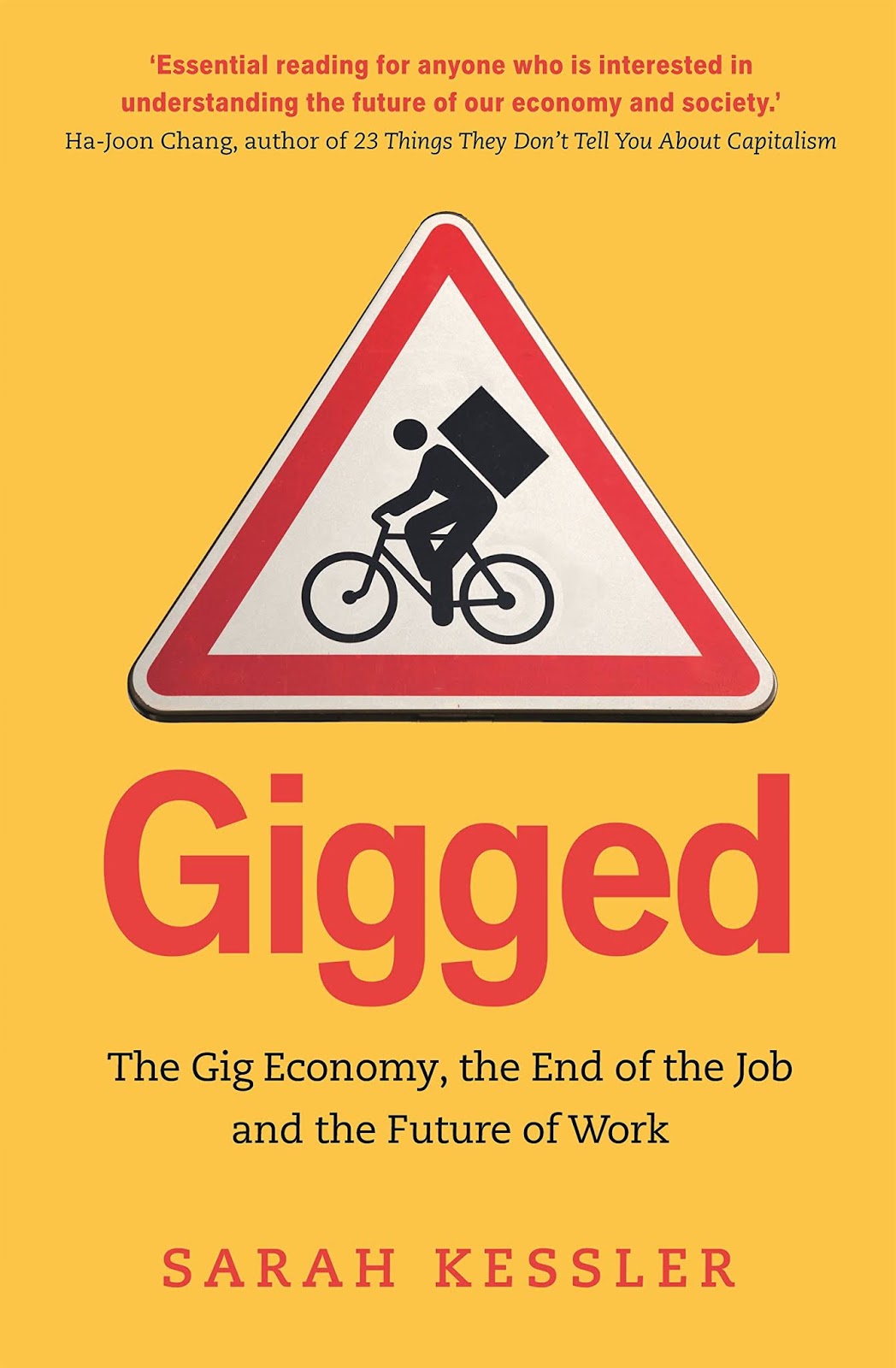
Sarah Kessler (2018), Gigged: The Gig Economy, the End of the Job and the Future of Work, Random House, pp. 288

What does it mean to be a young person looking for her first job after school today? The traditional path to dignity, stability and independence that work offers is fast receding in the age of the fourth industrial revolution with the advent of automation, artificial intelligence and on-demand platform economy. Just like the industrial revolutions before, this process is redefining work and the role of workers. Unlike the industrial revolutions before, this process is evolving so rapidly that the shelf life of a new business idea, the technology that drives it and the organizational structure that supports it is morphing in a matter of days. Great wealth is made in a few years and great losses too.

Such upheaval piles an unprecedented amount of risk and insecurity on the shoulders of workers who are taking the mantle of independent contractors, freelancers, consultants, temporary, contractual and part-time workers. When a large number of jobs informalize, the scope of worker rights diminishes. Financial and income security are traded for the much advertised ‘flexibility’ and ‘autonomy’ that the changing nature of work poses. Naturally, venture capital interest is substantially geared towards those ideas like that of Uber that has minimum infrastructure and maximum revenue potential.

This is the world of gig. Sarah Kessler does a fantastic job of taking us on a tour de force of the new world order. She does this through the voice of employers, workers, and tech entrepreneurs who make up this space. She traces the idea of work and wealth historically and places it against the rapidly collapsing first decade of the twenty first century world of work. She brings out the contradictions of the arguments that justify gigging the economy, and the concerns that embed it. She talks freely and frankly to people dreaming of opportunities and those struggling to make the ends meet. She observes, comments and fills the gap of their narrative with details and view points that presents a compelling perspective.

This is a fine introduction to anyone who wants to understand the nature and scope of the gig economy. Kessler is a tech blogger, tenacious researcher and compelling storyteller. Equally accessible to a specialist and novice, this book lays bare the essentials of a complex economic system through lucid prose. Befittingly, the biggest endorsement of the book comes on its front cover from none other than the master economist narrator and Cambridge professor Ha-Joon Chang! If you loved ’23 things they don’t tell you about capitalism’ by Chang, you could read this book as ‘a few important things they don’t tell you about the gig economy’. Exciting read!

Friday, 3 April 2020

Walk the Talk


Carmine Gallo (2014). Talk like TED: The Nine Public Speaking Secrets of the World’s Top Minds, Pan Macmillan, pp.278

As the flu darkens our horizon, what we need more than ever is a constructive way to spend time in confinement. The perfect book that can comfort and enlighten us through these times is either the good old classic that reminds us of things we mastered once or a manual that enables us to learn something new.

This month’s book is an engaging version of the second kind. ‘Talk like TED’ explores the question, what makes great speeches and how you can deliver one. Author and former CNN correspondent Carmine Gallo rummages through 150 hours of over 500 TED talks to find patterns that make speeches unforgettable and inspiring. He deconstructs the actual performance of the speech, interviews good speakers, and researches ideas from psychology and neuroscience to understand what makes modern oratory tick.

Making Hearts Sing

Gallo argues that all good speeches have three qualities- they are emotional, novel, and memorable. The emotional component of a good speech is delivered because of the passion of the speaker. What makes your heart sing is something that is intensely meaningful to you that forms the core of your personality. Only such great passion can elevate the hearts of others. Whilst thinking of a theme, the first thing to introspect is what inspires you.

The second quality, novelty is not the easiest aspect to bring into your speech in the age of information. Gallo argues that novelty need not be new information, but new ways of presentation. All good speeches (and definitely TED talks) had jaw dropping moments - be it jokes, anecdotes, props or visual aid. The reason novelty is such a powerful pull factor is because learning activates dopamine production in our brains, giving us the same kind of excitement that gambling does!

Finally, the third quality that Gallo discusses is ‘being memorable’. This aspect is cultivated through relentless practice.  Intense repetition of an act not only improves our confidence and timing, but opens new pathways in the brain that reacts differently to content. A pattern emerges in your presentation that links the different parts as part of a larger whole.

Both as a commentary and a manual, this book is a brief, fun, and exciting read to hone your skills at presentation. When the world opens to you again, be ready with something great!

Monday, 2 March 2020

In Search of Love


Madhuri Vijay (2019), The Far Field, Fourth Estate, New Delhi, pp. 432

Madhuri Vijay is a debutante with a compelling story. Her novel ‘The Far Field’ won the JCB prize for literature in 2019. I got hold of the book with the beautiful cover art and wonderful story telling about identity and memory in contemporary India. This story of the mother-daughter developed first as short fiction in 2010 and was subsequently developed as a novel. Vijay’s voice is tender and distinct, and is an asset throughout the narrative.

‘The Far Field’ is the story of a young woman in India who drifts away in life until a powerful memory from childhood triggered by her mother’s death, leads her on a mission to understand her past. Her journey takes her to militant Kashmir in search of a familiar face only to get entangled in an irredeemable quest. The narrator-protagonist is unreliable and vulnerable, evoking alarm and sympathy in equal measure. The anti-hero telling a story of anti-climax is essentially the essence of the tale, although there are layers and depths to explore.

Echoes and Mirages

One device that Vijay uses masterfully is the ‘echo’. There is a constant reverberation between childhood and adulthood, Bangalore and Kashmir, mother and daughter, that gives us the feeling of shifting time, space and gaze. This is a great narrative device to show comparison, contrast and the manner in which arcs end and cycles come to pass. In many ways, the daughter avenges her mother’s death but the brooding, meandering valley and the story warns us of what is to come.

At another level, this is a story about the impossibility of redeeming the past and the relying on memory. What is gone is gone forever and to wade into incomplete stories is to rip apart its integrity. Memories can be mirages that lead nowhere but to further illusions. Perusing such illusions cannot but end in doom.

This is good fiction coming out of India asking the larger questions of political identities through the personal quest of love and loss. The description of bustling towns and the quiet valleys of Kashmir are evocative. The human and natural characters from the valley are portrayed with flair and compassion. The portrait of Kashmir through the silent mountain, the gurgling ravines, the vigilant cows and goats, the incessant weaving and the busy everydayness of life is on point. The light and shade, the people and the forces parallel each other in a dreadful deadlock.

As we celebrate women’s history month, a fresh voice asking us difficult but important questions is here with us.


Saturday, 1 February 2020

Economics for the Future


Abhijit V. Banerjee & Esther Duflo (2019). Good Economics for Hard Times, Juggernaut, New Delhi, pp.402.

Banerjee and Duflo are back with arguments for conceptualizing economics that is useful to build the future. This is the second book of the Nobel Prize winning duo (https://www.nobelprize.org/prizes/economic-sciences/2019/banerjee/lecture/) and real-life economist couple after their debut ‘Poor Economics’ which was reviewed in this blog (http://thehouseofbooks.blogspot.com/search?q=Poor+Economics). The authors take on the biggest problems facing humanity today- climate change, automation, immigration, welfare and poverty- and explore how a better use of economists’ frame can help solve them. Armed with data, case studies, relentless humour and tender feeling, this work is rigorous as it is humane.

Critique of Economics

The book begins with a frank critique of economics as it is practiced today. Economists come in for a fair share of brickbats for their obsession with economic growth as the ultimate yardstick of good policy making, the method of trade liberalization as a means to achieve them, the unwillingness to move from assumptions of rational economic choices and the inability to connect with the larger public on issues that impact the average person. Crouched under the complexities of fallacious assumptions, mathematical modelling, and inept communication, economists have created a wide gulf between themselves and the rest of the world. Banerjee and Duflo argue that continuing along these traditions is unhelpful as it is unethical. They call for an approach that uses realistic assumptions and make bare the caveat emptor rather than continuing with misleading simplistic versions of the world.

Analysis of Issues

One of the biggest takeaways from this book is the way the authors examine some of the pressing issues today by presenting deliberate questions that challenge commonly held assumptions. For example, all over the world there is a surge of fear against immigrants as arguments abound that they reduce chances of employment and welfare of others. The authors examine immigration both from historical data and theoretical assumptions to bring out what happens to the local economy when groups of a particular skill-set immigrate? Who wins and who loses and what is the long-term impact? The nuances in their reasoning give clear pointers as to how the problems could be solved. The authors caution that careful intervention, not outright prohibition is the way forward.  Similarly, other issues such as automation, welfare and climate change are dissected with reasoned arguments and empirical evidence.

Banerjee and Duflo are known for writing eminently readable books which provoke our thinking and arouse our feeling towards action. They do not disappoint this time. Their canvas is bigger with better challenges to tackle head-on! A great book to begin your year and decade!