Saturday, 6 January 2018

The Age of Rhizomatic Revolutions


Manuel Castells (2015). Networks of Outrage and Hope: Social Movements in the Internet Age (Second Edition). Cambridge: Polity Press, pp. 316.

Manuel Castells is an eminent sociologist who has revolutionized the way we understand communication in societies, especially through his study of social movements. An emeritus professor with the University of California Berkeley and a visiting professor with Oxford, Cambridge and MIT, he has penned over 25 books, the most celebrated of which are The Information Age and Communication Power. In this refreshing work on new social movements, originally a product of the CRASSH lecture series of Cambridge, Castells dwells on the eruption of Arab uprisings, indignadas of Spain, occupy movements of the US, and the social protests in eastern Europe and Turkey that have shaken the world in recent times. He attempts to understand what these movements imply, in the context of our nebulous times.

Castells examines the nature and scope of these social movements and asks whether the qualification ‘new’ is apposite. He brings out the common characteristics of these seemingly unrelated events. He argues that these movements initiated new trends by ignoring political parties, often going beyond the hype of ideologies. They also distrusted the traditional media and rejected formal organization. These uprisings eschewed traditional leadership and relied on the internet and local assemblies for collective debate and decision making. In short, these social movements, according to Castells, used ‘autonomous networks of communication’ that differentiated them from traditional social movements that were embedded in societies.

Counter Power and Communication
Castells, then goes on to delineate the power of ‘occupation’ that the new social movements have consistently used. He argues that physical occupation of a town square or a street, that was the central symbolic act of these movements, were also symbols of invasion of state or financial power of institutions and an affirmation of right to public and collective use of these spaces. Drawing historic parallels between the Paris Commune of 1871 and the Glasgow strikes of 1915, he demonstrates how the new social movements derive strength in solidarity and togetherness as a weapon against risk, uncertainty, fear and exploitation. Castells’ core argument is that although there are structural causes of institutions and individual causes of emotion that makes social movements possible, the new movements are a prescient sign of passionate politics and not a traditional type of political program and strategy.

The implications of Castell’s arguments are two-fold- (i) that the new social movements are a product of a ‘networked’ society, and that (ii) these are symbols of ‘counter power’. By employing a grounded theory approach to new social movements, Castells demonstrates that the formation, dynamics, values, prospects and enquiry into the new social movements bring out the facets of a ‘networked’ society with different nodes of operation. Social communication in these networked societies has taken the form of ‘mass self-communication’, where an individual can program and switch on networks of power because of her/his reach through the new types of media. These communication strategies then emerge as a form of counter power, against the coercion, legitimization and communication of traditional power.


Whether the new social movements have resulted in victories and concessions, or armed repression and civil wars, they are rhizomatic (coming from the ground) and have a democratic and radical appeal. The framework of communication and examination of the power politics is an important and interesting lens with which to evaluate these new movements. An exciting way to begin the new year with a voice of our times!

Sunday, 17 December 2017

The cuckoo’s egg in the Nobel nest


Avner Offer & Gabriel Söderberg (2016). The Nobel Factor: The Prize in Economics, Social Democracy and the Market Turn. Oxford: Princeton University Press, pp. 323


Prizes and honours are not just acknowledgement of merit and excellence in a given field, they are rituals and symbols, as well.  The Nobel prize, annually given to outstanding work in various disciplines, has particularly acquired an aura and prestige that makes it an unrivalled realm of excellence. The four institutes of authority who select the winners of the Nobel prizes are the Royal Swedish Academy of Sciences, the Swedish Academy, Karolinska Institute and the Norwegian Parliament (for the peace prize). The Nobel memorial prize in Economics differs from the other prizes because it was constituted by the Swedish central bank in memory of Alfred Nobel in 1969, and was not one of the original prizes awarded since 1901. One of the earliest critiques of the economic prize was that economics was driven in the real world by politics. However, over the years, economists have brought in a particular use of ‘scientific method’ to economics and argue that economics remains closer to the physical sciences in methodology. This book looks at this argument and critiques it both with respect to methodology, and ideology that guides economics in practice. The authors argue that the construction of ‘merit’ of economics has been through calculated deliberation in a way that outcomes are increasingly difficult to predict. There is an assumption that there could be an objective criterion for ranking merit and the Nobel committee has a methodology to reach this calculus.

Model thinking and market turn
The authors begin their argument by invoking the historical thinking that placed economics as political management of economy or moral philosophy by Adam Smith and John Mill. This earlier tradition was opposed with the introduction of positivist thinking in the mid twentieth century. Milton Friedman’s article ‘The methodology of positivist economics’ published in 1953 is one such example.  The authors argue that ‘model thinking’ in economics began with this market turn. Formalist branches of economics use model, not as a plausible representation of the world, but as an instrument with internal consistency. The criteria of validation from the empirical world is not a necessity. As a result, models of economics not only diverge from real world situations, but predictions based on these models routinely fail.

The impact of formalist economics has been to vilify models that actually work on the ground. The authors give the example of welfare state. Social democratic forms of state offer two kinds of support structures against uncertainty and risk.  At an individual level, risk is reduced through state-supported housing, education and healthcare and at a collective level, life-cycle dependencies are met through welfare. This mechanism involves two types of transfers- transfer from present to the future in an individual life and lateral transfers across generations in a society. These support structures have been the bedrock of prosperous and equitable societies in many countries. The rational model thinking economics, by critiquing the inefficiency of this system, has pushed societies into market-centrism. This has resulted in an unprecedented vulnerability of many sections of society.

Decoding Nobel prize impact
Did the most visible prize in economics have a role to play in the way economics is envisaged today? Offer and Söderberg use an interesting methodology of correlating citation of prize winning academic papers, ideology implied in the arguments and economic prize winners to determine whether the prize had a definitive (ideological) market turn. Their empirical study over the period till 2005, show three interesting results. First, the economics prize has been awarded on a balance between ideologies of left and the right, formalists and empiricists, Chicago school and Keynesians with the exception of the period 1990-1997, when all winners were of the neoliberal argument. Second, there has been a decided shift from work that was predominantly theoretical to that which is empirical. For instance, in 1983, 57.6 per cent of the total articles published in the top three journals in economics were theoretical, where as it was 19.1 per cent in 2011. On the other hand, empirical articles jumped from 3.2 per cent in 1983 to 42.2 per cent (Offer and Söderberg, p. 56). Third, the authors argue that of all the prize-cited works of economists up to 2005, only 5 percent were based on the scientifically rigorous idea of falsification, 12 per cent were of less reliable verification criterion and 20 per cent of confirmation criterion that was not supported by the scientific method. In other words, going by the strict criteria of scientific method, only a few works in economics would comply with the rigour.


The ultimate argument of the book is that the mechanical balancing act of the selecting prize winners in economics belies the belief in scientific regularity and reasoning that is believed to be at the heart of the discipline.  Choices in economics is a matter of preference and not fact. Real choices are difficult to make within a situation of unknown future, risk and uncertainty. Rather than reason, discretion becomes a commitment device for individuals. Economic choices may be driven by non-economic factors like ethical and normative preferences in addition to seemingly irrational decisions taken as a result of cognitive limitations. The ‘merit’ of the Nobel winner then becomes a task of ‘construction’ that is driven by extraneous considerations like ideology. The Nobel memorial prize begins to look a lot like that of literature and peace than those of the sciences.

Friday, 3 November 2017

A ghost-love story


George Saunders (2017). Lincoln in the Bardo, Bloomsbury

‘These and all things started as nothing, latent within a vast energy broth, but we then named them and loved them, and, in this way brought them forth. And now must lose them.’
        roger bevins in Lincoln in the Bardo

This is the Man Booker winning experimental debut novel from George Saunders. The story opens in the United States of mid nineteenth century, with President Lincoln’s son Willie fighting for his life, while the country is gripped in civil war. Willie dies and is buried in a Georgetown cemetery in a marble crypt. His mother descends into grief and madness. The President is bent on returning to his son as he visits the crypt and talks to him lovingly. This agonizing love, guilt and longing reaches his son across the veil of death.

The Bardo- which in Tibetan language means ‘that place between life and death’- is populated with a bevy of rich characters, all in a state of oblivion. People of all sorts have carved out a space for themselves in this netherworld, the high and the low, god fearing and nihilists, with their friendships and subterfuge. Into this world, little Willie descends, expecting his father to come and visit him again. The entry of the little boy creates a new sensation among the inhabitants of the lively Bardo and they unite to help Willie ‘pass over’. For this plot to succeed, they must have an unlikely ally- the President himself. How Willie is transported on through the unlikely alliance of his father and the Bardo, forms the rest of the story.

The central theme that runs through the story is that of love and loss, the deep human ache to retrace lost tracks and reclaim our pasts. Saunders shows us a way of moving on after a devastating loss, not by forgetting, but by letting go, accepting, freeing ourselves from the burden of care for the loved one. He attacks the very idea of loving by living, by showing, by acting- our love for those who are dead should be a different kind of love. It cannot find meaning in the repetitive acts of expression through words and deeds, for this creates a tomb of the past, a never-ending mourning. A graceful way of loving the dead is to not act or talk but to think, to ache and hold. It is not a love that hinges on sharing, sympathy and reciprocity. It is a silent one-sided love, not prone to the tempest of action, time or space. That is how love for someone who is absent looks like.

The deep contrast to Lincoln’s throbbing aching love is the cohort in the Bardo, ebullient, devoid of all memory and sense of being. They are literally a ghost of their previous Saunders uses the oldest trick in the book to make the imaginary world real- by turning metaphors into their heads. They are accustomed to a charade, a clinging on to the most mundane that defined them when they were alive. Willie’s arrival infuses a human-like feeling in them for the first time- passion, purpose and fellow feeling.  Eventually helping Willie to freedom helps the Bardo to free itself.


This unusually poignant novel works because of its audacity- the narrative style, the imagination at one level, and the philosophy that is conveyed through polyphony that testifies to love, loss and what it takes to heal and be free.

Sunday, 8 October 2017

The Master of Spare Elegance


Kazuo Ishiguro (1989). The Remains of the Day, Faber and Faber, pp. 258


With the 2017 Nobel Prize in Literature coming to Japanese-born British writer, Kazuo Ishiguro, the turf of literary feud (since the award was given to Bob Dylan last year) has calmed down. Ishiguro, a literary polymath, has written seven novels in addition to screenplays, short fiction and lyrics. It is a great time to revisit one of his much-loved novels and the winner of the Man Booker Prize 1989, ‘The Remains of the Day’.

This novel is about the short journey that Stevens, the butler of the now decrepit Darlington Hall, takes across west countryside of England. Stevens has tirelessly worked for the distinguished family of Darlington Hall during the inter-war years, and the second world war. His old master is dead and in his place an American comes along, retaining Stevens as part of the ‘package of an old English house’. Stevens struggles to fit in the ‘new world’ of careless banter and informality. He feels a little lost, bereft of older ideals and notions of honour.

It is when Stevens is struggling with change, that an unexpected holiday comes. An opportunity to leave Darlington Hall for a few days gives him a chance to reflect on his life and work. He stumbles upon the truth about his lost love and his old master’s fall from esteem in the eyes of the world. It is a poignant journey of epiphany, but the realization of truth is by slow and painful degrees with the glacial chipping away at the fog of illusion that holds the protagonist intact.

Reflections on the Past
Stevens look at the past begins as a fairly straightforward narrative, with his neat, organized and sparse mind that never regrets. He believes that staunch loyalty to work and ‘dignity’ of conduct above mere competence, are what makes a butler truly ‘great’. He is looking back at himself at a time when the world has little use for his virtues and his place in the order of things stand precipitous. Happy and non-oblivious to the mechanization of the larger world of affairs that he stands by waiting every day, and the smaller microcosm of his own life, he evaluates and validates his life.

His contentment and pride are shattered by revelations that take place throughout his holidays. Often poignantly told to him directly by others who love him, he becomes aware of what he has lost. With a few pages to spare in the novel, we witness Stevens understanding his life for not just what it was, but also for what it could have been. He sees the trade-off, the point where there was a choice and how he missed it completely. And what he decides from there, is the rest of the story.

The theme of an unassuming protagonist and his journey towards truth is recurrent in Ishiguro’s works. In his other novel, ‘The Artist of the Floating World’, truth is stubbornly refused by the artist even as it stares at him. The acceptance of truth and the awareness of loss that comes with it, are done only when it is inevitable. Ishiguro takes his readers through these small inner worlds of people with great austerity and sympathy. The epiphany is not of the Joycean artist as a young man so that it reveals a world of possibilities ahead. It is the lives of individuals nearing the end of their lives, and the thick fog of possibilities that could have been is heart breaking. How Ishiguro’s protagonists negotiate these bargains forms the enduring philosophy of his works.


Thursday, 28 September 2017

Two Accidental Prime Ministers

Daman Singh (2014), Strictly Personal: Manmohan and Gursharan, HarperCollins, pp. 452

Vinay Sitapati (2016), Half-Lion: How P.V. Narasimha Rao Transformed India, Penguin India, pp.399

1991 is increasingly considered a ‘water-shed’ year in modern Indian history because of India’s formal decision to open up parts of its economy through a process called liberalization. After decades of Soviet-style planning and a consistently lower rate of economic growth (that hovered around 3 per cent) since Indian independence in 1947, liberalization was a break from the past. However, the historic decision to open the economy was not done through parliamentary debate, but by political stealth. This was because liberalization was a sensitive issue politically, and the then imminent balance-of-payment crisis made the decision inevitable. The prime architects of this historic moment were two accidental power bearers- P.V. Narasimha Rao, the then Prime Minister of India, and his finance minister Manmohan Singh, who later became India’s Prime Minister for a decade (2004-2014). They were ‘accidental’ because both were chosen by the political establishment for being a compromise candidate who was agreeable to most members of the power coalition. Incidentally, these two historical figures have received less academic interest than the pantheon of other political figures in modern Indian history. The two biographies under review here, fill the research gap to some extent, although they are two very different kinds of books.

The first book ‘Strictly Personal’ tells the story of Manmohan and his wife, Gursharan, written by their second daughter, Daman Singh, after prolonged interviews with her parents about their life. The book reproduces the narrative of the protagonists in their own voices. This is the most personal that a published work gets to Manmohan Singh. The best part of the book is the first section, recounting the early years in undivided India (present-day Pakistan), where Singh grew up with his extended family. This part also dwells on his many loves, passion for learning, and his Oxbridge years. Manmohan speaks freely with a tinge of nostalgia for his childhood with a deeply evocative reminiscence, ‘I wish I were a child again’. In the second half of the book, he recounts his impressions of people as he went to work in high offices in New Delhi and his own convictions as he presented the decision to open up the economy as the Finance Minister of India. In this part, there is no counter voice given to Singh’s own thoughts and this decontextualizes what he attempts to reveal. Perhaps, this is the shortcoming of the book.

The second book, ‘Half-Lion’ is a sweeping and flamboyant political biography of Narasimha Rao, penned by Princeton scholar Vinay Sitapati. There is an account of his early years, but it is presented with an eye on the future, when Rao will sit on the highest political office of India after years of political wilderness. Rao’s unfailing memory, his deep mistrust of others outside his coterie of friends, his undying faith in fate and destiny and his obsession with technology bring out the inevitable contradictions in his persona that makes him an interesting character. Rao comes across as an uneasy combination of the pragmatic politics of Kautilya of the ancient past and unadulterated idealism of the Nehruvian era. It is this contradiction that makes him a ‘half-lion’- often decisive, but terribly secretive. The book also freely uses never-before-seen archive of letters from Rao’s personal collection.

Reading both the books together resurrects two important historical personalities and gives a glimpse of what really went behind the minds of the prime architects of India’s liberalization. As historian Ramachandra Guha remarks in the introduction to his edited volume ‘Makers of Modern Asia’, biography as a field of scholarship is under-developed in Asia and particularly in India. Recent interest in modern political figures in India such as Rao and Singh, is a welcome development.

Thursday, 3 August 2017

The Forest of Exile


Nandini Sundar (2016). The Burning Forest: India’s War in Bastar, Juggernaut, pp. 413

In the mythical landscape of India described in the epic Ramayana, Dandakaranya or the Dandaka forests, is a land of exile for the protagonist Ram. It is here that he sheds his identity and the privileges that come with it, faces his own demons, fights and overcomes covert and overt enemies and makes decisions in the face of ethical dilemmas. Bastar, the contemporary counterpart of Dandakaranya, in the southern part of Chhattisgarh in central India, has been posing a new kind of dilemma to the social and political fabric of our protagonist, the modern Indian State. In these forested hills for more than three decades, Maoists have almost run a parallel state, distributing land, settling disputes and entering into contractual relations with its inhabitants. It is here that the Indian state fights its counter insurgency operations against the Maoists and with it the poorest inhabitants, whose citizenship have been devoid of rights and distributive justice, reduced to a ‘law and order problem’. In all these dramatic accounts of a war and counter war, the average Indian in the forested hills is at best obscure- this book digs her out of the crossfires of conflict and evocatively tells her story.

This important book comes out of over three decades of research in the Bastar region in India by renowned anthropologist and Infosys Prize winner, Nandini Sundar. The author dvelves into her extensive field experience, and from the vantage point of an academic and intimate outsider, lays bare the nuances and contradictions of the raging war in Bastar. The book is divided into three parts. In the first part called ‘The Landscape of Resistance’, Sundar locates the struggle in the social and political exploitation of the adivasis. In the second part called ‘Civil War’, various forms of insurgencies and counter measures from the state is analysed, to bring out the severity of the vortex of violence in which Bastar is steeped in. In the last part called ‘Institutions on Trial’, the reaction of various actors including politicians, human rights organisations, media and judiciary are brought out. Sundar argues that there are only a few opponents to this war in the forests of Bastar and fewer institutional and structural checks and balances from the state to excesses against its own citizens. It is because of this failure of state in the face of corporate or political greed and against its own citizens that the ‘violence, even against injustice, degenerates into brutality and corruption’.


This book is about a war by India’s poorest to reclaim land and property, a battle to co-opt traditional power struggle in an ideological insurgency and the state’s last attempt to hold its bastion of political authority. It speaks from the viewpoint of an average Adivasi and her need to keep the Maoist and the Indian state in and out in carefully measured political spaces. It directly pits the conundrum of the citizen to choose between security or development, state or protectorate vigilantes, food or land, road or jungle. It exposes the discourse that uses development as a weapon to get consent of people, security as threat to land and livelihood and elections as battle ground.  It speaks of the propaganda wars of a significant part of media and the response of judiciary, both guardians of democracy, in the three decades of unceasing internal violence. It also unflinchingly admits the limits of cause celebre campaigns and civil society movements because of the difficulty in articulating the position of the average citizen on whose behalf political action is demanded. This is a deeply researched portrait of struggle for citizenship and raises important questions for Indian democracy based on field research, court testimonies, government documents, media reportage and field participation. 

Friday, 7 July 2017

The Second Homecoming


Arundhati Roy (2017). The Ministry of Utmost Happiness, Penguin, pp. 445

When Arundhati Roy debuted with The God of Small Things, we were introduced to the expanse of spaces between people in her world, that both shaped and blurred them. Love, hate and everything between flowed among the characters like subterranean rivers, silent and deep. Exactly two decades after her first novel, she has arrived with The Ministry of Utmost Happiness. This is a story that is a world apart from that intimate exploration of the tiny village-world of Aymanam of her first novel. The world that this story takes places is all of India that is relegated. It is the spirit that pervades border and the heartland with equal alacrity, which does not fit with the temperament of the big narrative that makes India today.

The protagonist is characteristically, a trans-person, who is also a single parent. She occupies the ultimate borderland-between the alive and the dead- and lives in a cemetery in old Delhi. Strangers, who are mostly renegades, pass through and affectionately people her world. They come from the forests of central India to the valley of Kashmir, belong to all genders, creed and credo. They fight a narrative that steals their truth, hides their identity and muffles their voices. Yet, they are all thieves of another kind- secret keepers of conscience and inheritors of a disowned pedigree. In the corner, away from the rest of the world, they find friendship and fellow feeling, laughter and love.


Between the first and the second novel, there is a two decade long pause- in which Roy traveled many worlds within India. Her books of non-fiction, Listening to Grasshoppers, Broken Republic and The Algebra of Infinite Justice, critique and question the Indian state from the point of view of the adivasis, the displaced people at the wrong end of development and communities at the borderlands, especially Kashmir. Through this work of fiction, Roy explores the intensity of what it means to be marginal and the terror and insanity of violence that pervades lives at the margin. On her impulse to write fiction again, she recently remarked in an interview to The Hindu, “There was this huge sense of urgency when I was writing the political essays, each time you wanted to blow a space open, on any issue. But fiction takes its time and is layered. The insanity of what is going on in a place like Kashmir: how do you describe the terror in the air there? It is not just a human rights report about how many people have been killed and where. How do you describe the psychosis of what is going on? Except through fiction.” It is these layers of truth and the insanity of violence that is at the heart of this stunning second novel. 

Monday, 12 June 2017

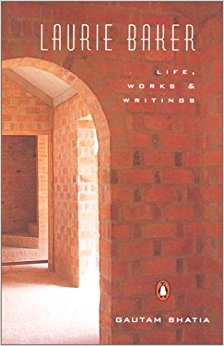
Building, the Baker Way


Gautam Bhatia (1991). Laurie Baker: Life, Works and Writing, Penguin Books, pp. 312.


I chanced into this book on Laurie Baker, the delightful British architect who stayed a long part of his life in India, the same way I bumped into one of his own creations- by pure accident. A few years ago, I was eagerly stepping into the grounds of Centre for Development Studies in Trivandrum (southern Kerala) for visiting the library to browse through its delectable collection of books. I was spell bound by the beautiful buildings nestled in the quiet grounds and for a change, preferred staying outdoors to the reading hall.

Laurie Baker stayed in India, first in Pithorogarh district in the valley of Himalayas for sixteen years and then in Kerala. A chance encounter with Mahatma Gandhi at the height of Quit India movement in 1942, led Baker to a maxim that true independence can come only when self-reliance and local craftsmanship was employed in building the nation. Gandhi’s message instantly struck a chord with young Baker since it resonated with his intense religious faith (he was from a Quaker background) and his own professional training.  The bare simplicity of his architecture (constructing only the essentials) and the blunt honesty of his structures (where mud looked like mud and brick, like brick) is a veritable reflection of his realised faith and the harmonious balance between his work and life.

Understanding the vernacular
One of the cardinal principles of the Baker method of building is the appropriateness of traditional methods- using locally available material suited to climatic conditions with locally available skill and technology. For him, originality lay in going back to the origins, the tried and tested method of trial and error, by which people over thousands of years participated in an ever-going research to build enduring, meaningful, cost effective and sustainable buildings. Most of Baker’s architecture is uni-style, using mud, locally made tile and bricks, particularly suited to the tropical climate of Kerala.

In his writings, Baker muses on the centrality and the marginality of the architect. The architect is the primary individual who has to see the problems of construction through to the end, and not fall back upon other ‘structures men’ like the engineer or the carpenter. From the realm of ideas and drawings to the final outcome as a tangible structure, a building results when an architect constantly intervenes and relentlessly controls the process. Yet, in a beautiful contradiction of roles, Baker calls the architect an extra, the side piece, an outsider, who merely realises another individual’s attachment to his place of dwelling, a family’s sense of security and familiarity. This deep involvement in his craft and empathy with his clients makes him a humanist builder.

Problems with modern architecture
Baker is unsurprisingly a critique of modern mass production of buildings at high cost using unsustainable methods. At the turn of the twentieth century, when modernism was setting in, there was a widespread belief that technology would facilitate the arrival of facilities at affordable rates to ordinary people. This was especially true in case of housing with rising demands and shrinking resources. Baker argues that modern movement took a sterile turn for the worse with the industrial economy taking design over. Humanistic considerations no longer remained centre-stage in housing projects. The advent of cement, steel and glass has transformed natural ways of building homes into a purely industrial enterprise.

This break from tradition also implied the coming of the anonymous, impersonal buildings. The need to evolve buildings amidst severe resource constraints and the emphasis on speed tyrannised the creative part of architecture, shifting its focus from earthy humanism to technology. Mass production of building parts by mechanised production has overwhelmed expenses and underperformed at the demand side, literally pushing people to homelessness.

Baker’s method is one of the important and sustainable answers to the housing problem in a country like India. The simultaneous understanding of change and tradition is at the heart of meaningful evolution of building cost-effective homes. Assembly-line approaches cannot grapple with the idea of space, habits of tradition, possibilities of imagination and the unarticulated specification of geographical condition. Baker has built a vocabulary of these elements in each of the thousand buildings he has constructed over five decades in India. His client list includes the iconoclastic individual, the imaginative community and the bureaucratic institutions.

The delightful book is divided into three parts- a commentary on Laurie Baker’s architecture by renowned architect Gautam Bhatia, details of forty select buildings from thousands of Baker’s architectural creations and Baker’s own inimitable writings and speeches, most of which are unpublished. Baker’s writing lucidly brings out his ethos, his methods and vision for housing in India. There is a list of appendices which present Baker’s cost-cutting manual and guidelines to cost effective building strategies. For an architect- academic, a more formal presentation of Baker’s work, authentic photographs, plan layouts and academic referencing would have been of help. But for the lay reader who enjoys architecture, this book is a great introduction to an iconoclastic architect who gave India a lot to cherish for.

Thursday, 11 May 2017

The American Imperative


Colson Whitehead (2016), The Underground Railroad, London: Fleet, pp. 306


‘In America, the quirk was that people were things.’
                                                  
If you are a thing, your value depended on your possibilities. After being appraised and reappraised in the scales of other men’s visions, you knew your value and your place in the order of things. To escape the confines of this hierarchy was to escape the principles of your existence. The Underground Railroad, winner of Pulitzer Prize Fiction 2017, is a daring novel that maps the journey of escape of a slave girl as she traverses the physical terrain and foundational myths of America.

Three generations of slave women- Ajarry, Mabel and Cora- are at the heart of the story. While grandmother Ajarry was sold from Africa and died in plantation after being sold and resold many times over, her only surviving daughter Mabel attempts to escape the plantation and is not seen thereafter. Cora, Mabel’s daughter, is living as a stray, outcast among other slaves. She is part of the Hob that has seven outcast women who have insulated themselves from the insinuations of the world around them because of their reluctance to mix with others. As she is fighting for her ‘three square yards of dirt’ within the plantation where she grows her own garden, she meets Caesar, a former freeman from Virginia, who offers her passage to freedom through the ‘underground railroad’. Cora is compelled to take this offer and she sets off on a dangerous journey to go to the free states up north.

Upending metaphors
In this vicarious pathway to freedom and dignity, Cora encounters different states, each a possibility of an alternative America. In each of these steps, she encounters a terror more unprecedented than the previous. Cora understands that you do not need chains to imprison a person- the purpose of chains was accomplished in so many different ways. The seemingly harmless hospital in South Carolina is a hub of eugenics that subjugates black people through controlled sterilisation and her refuge (a nook in the attic of a white man’s house) in North Carolina is no more than a secret prison. Cora understands that ‘the world could make living prison of your safe haven.’ As she passes through South Carolina, North Carolina, Tennessee and Indiana, a miraculous combination of faith and friendship, takes her to her freedom.

What makes the novel stunning is the way metaphors and myths are turned on their heads, to live out their literal existence. Colson Whitehead sketches the details of the underground railroad by making the metaphor live its meaning, bolts and all. The railroad literally spreads like invisible vein of slave transport, an empire with its own logic, under the foundation of America. From this underbelly, it chisels away at the foundational myths of the American Declaration of Independence- the promise of equality, freedom and dignity to all its citizens. Cora hears of the Declaration recited by a slave and thinks of it as a ghost from the darkness. Later her language tutor Georgina tells her, ‘The Declaration is like a map. You trust that it’s right, but you only know by going out and testing it yourself.’ When Cora ventures out, truth comes to her as a sudden engine from darkness dislocating all her beliefs, breaking her. When she works as an actor in a history museum in South Carolina, playing out a slave for the white audience, she thinks of truth as ‘a changing display in a shop window, manipulated by hands when you weren’t looking, alluring and ever out of reach’. Simple theatre becomes a refuge of faith that comforts her. It is this same mistrust in truth as revealed by history that makes her reject the Bible and poetry.  Cora understands truth, freedom and equality when the lived experience of her life confronts the inherited faith of her society.

Questioning history
The American landscape is portrayed with as much brilliance as the mindscape of its people that run a ruthless machinery of order and hierarchy. The slave master and the slave catcher, the slave mother and the station agent, the grave robber and the abolitionist, are all the products of the same system. The philosophy of the slave catcher Ridgeway sums up the unstoppable racial logic, that the story portrays and disembodies, trenchantly. He believes that the true American Spirit was one ‘that called us from the Old World to the New, to conquer and build and civilize. And destroy what needs to be destroyed. To lift up the lesser races. If not lift up, subjugate, if not subjugate, exterminate. Our destiny by divine prescription- the American Imperative’. Ridgeway worked for this ‘American Imperative’ to ensure that property remained property. It was a notion of order, hierarchy of social arrangement and chain of value.


In the end, this is a story of one woman’s indomitable will to escape her destiny and find her way to freedom. Quite directly, it is her adventure through space and time in America where at each step a unique terror awaits. But this is also a meditation on history, our understanding of our pasts. In this light, the politics that works when black history is placed in the pages of white narratives attacks the foundational myths of the America. This story also brings out how technology moulds history, the tale of inventions and human endeavour to find a way out of difficulties, the kind of technology that is fantastic and adds meaning to life. Whitehead is claiming back something substantive here, but it is not something we are expecting. The novel is in the same vein of other defining works that took the idea of identity and turned it on its head- Julian Barnes’ England, England on the English question, Paul Beatty’s The Sellout on slavery and Howard Jacobson’s The Finkler Question on being Jewish. An important perspective for our times!

Thursday, 6 April 2017

Incurable Life


Atul Gawande (2014) Being Mortal: Medicine and What Matters in the End, Metropolitan Books


Atul Gawande is a medical researcher, surgeon and writer. Like most of the popular writers of science, he is an evocative story teller. He begins all his reflections from the practice of medicine, his vast clinical experience, inevitable questions of his patients and ruthless self examination of what it means to be a sensitive doctor in modern times. His narrative expands with his ambitious canvas, from the microscopic particularities of case studies, to the bigger questions that connect medicine with modern life. As the author of four bestselling books- Complications, Better, The Checklist Manifesto and Being Mortal- the core idea that he has dealt with in all his works, is how revisiting the role of expert can help in serving modern life better. He probes the limitations of his profession, the built-in ambiguities of practicing medicine and the problematic situations that require fine judgment from the practitioner. He is disturbed by the ‘tragic mistakes’ or the experts’ inability to effectively use the knowledge she has, to make better decision outcomes.

The fragility of caring
In Being Mortal, Gawande examines how modern medicine has dealt with old age with evasive unease. Medicine and public healthcare has ‘medicalised’ our existence so much that we treat death as a clinical procedure to be overcome. Serious illness, frailty and approaching death are sequence of a process none of us are immune to. It is at once, about the individual at the heart of the problem as well as about his loved ones waiting in the fringes. It is about dignity and control, choice and decision making when faced with the fear of loss and uncertainty. The autonomy and dignity that an individual has, makes the last days of his life, a kinder and warmer experience for him and his loved ones.

The book has two parts. In the first part, the author examines each available option of assisted living for the elderly and evaluates them. In the second part, he discusses the option of euthanasia and what assisted death has done to the idea of assisted living and palliative care. In his characteristic narrative, the author weaves his arguments with powerful stories, clinical case studies from different countries, personal encounters with patients, friends and family. Our singular concern with health, longevity and safety, he says, devalues the subjective values of what makes life worthwhile in significant ways. Instead of fighting for a prolonged life, Gawande argues for a life imbued with meaning to the individual concerned.

Changing perspective of healthcare
The book calls for a change in our philosophy of heath care and argues that our preoccupation with health should turn to well being. This is especially relevant as traditional societies like India are rapidly moving from joint-family to smaller family units. Care giving as we have known in these societies as a family-centric event is rapidly changing. This shifting perspective also alters the roles and responsibilities of the doctor, from being a mere source of information, to being a partner in shared decision making. The importance of palliative care and involvement of families become part of the solution.

The hard questions that the book raises are important; but there are no easy answers. One problem with Gawande’s style of argumentation is that qualitative case studies bring out the rich detail of individual cases but have to be backed by data to understand larger trends. Secondly, the autonomy of an individual with terminal illness becomes problematic when it is a case of dementia or Alzheimer’s. This aspect is not explored fully in the book. Even then, Gawande succeeds in raising the right questions for us to debate. As he remarks, ‘Arriving at an acceptance of one’s mortality and a clear understanding of the limits and the possibilities of medicine is a process, not an epiphany.’ This is indeed an important book for our times.