Wednesday, 6 May 2020

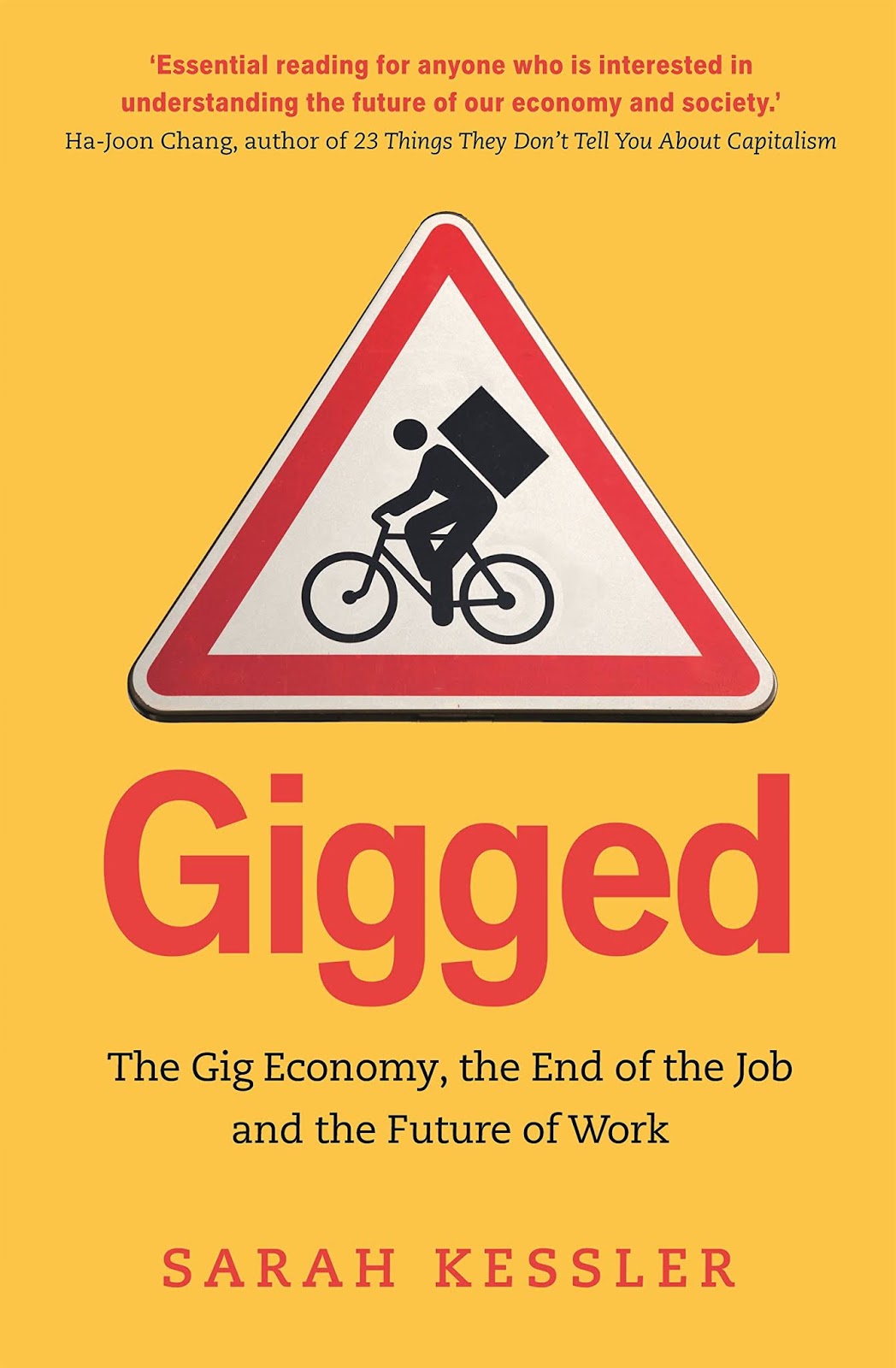
Understanding the Gig Economy


Sarah Kessler (2018), Gigged: The Gig Economy, the End of the Job and the Future of Work, Random House, pp. 288

What does it mean to be a young person looking for her first job after school today? The traditional path to dignity, stability and independence that work offers is fast receding in the age of the fourth industrial revolution with the advent of automation, artificial intelligence and on-demand platform economy. Just like the industrial revolutions before, this process is redefining work and the role of workers. Unlike the industrial revolutions before, this process is evolving so rapidly that the shelf life of a new business idea, the technology that drives it and the organizational structure that supports it is morphing in a matter of days. Great wealth is made in a few years and great losses too.

Such upheaval piles an unprecedented amount of risk and insecurity on the shoulders of workers who are taking the mantle of independent contractors, freelancers, consultants, temporary, contractual and part-time workers. When a large number of jobs informalize, the scope of worker rights diminishes. Financial and income security are traded for the much advertised ‘flexibility’ and ‘autonomy’ that the changing nature of work poses. Naturally, venture capital interest is substantially geared towards those ideas like that of Uber that has minimum infrastructure and maximum revenue potential.

This is the world of gig. Sarah Kessler does a fantastic job of taking us on a tour de force of the new world order. She does this through the voice of employers, workers, and tech entrepreneurs who make up this space. She traces the idea of work and wealth historically and places it against the rapidly collapsing first decade of the twenty first century world of work. She brings out the contradictions of the arguments that justify gigging the economy, and the concerns that embed it. She talks freely and frankly to people dreaming of opportunities and those struggling to make the ends meet. She observes, comments and fills the gap of their narrative with details and view points that presents a compelling perspective.

This is a fine introduction to anyone who wants to understand the nature and scope of the gig economy. Kessler is a tech blogger, tenacious researcher and compelling storyteller. Equally accessible to a specialist and novice, this book lays bare the essentials of a complex economic system through lucid prose. Befittingly, the biggest endorsement of the book comes on its front cover from none other than the master economist narrator and Cambridge professor Ha-Joon Chang! If you loved ’23 things they don’t tell you about capitalism’ by Chang, you could read this book as ‘a few important things they don’t tell you about the gig economy’. Exciting read!

Friday, 3 April 2020

Walk the Talk


Carmine Gallo (2014). Talk like TED: The Nine Public Speaking Secrets of the World’s Top Minds, Pan Macmillan, pp.278

As the flu darkens our horizon, what we need more than ever is a constructive way to spend time in confinement. The perfect book that can comfort and enlighten us through these times is either the good old classic that reminds us of things we mastered once or a manual that enables us to learn something new.

This month’s book is an engaging version of the second kind. ‘Talk like TED’ explores the question, what makes great speeches and how you can deliver one. Author and former CNN correspondent Carmine Gallo rummages through 150 hours of over 500 TED talks to find patterns that make speeches unforgettable and inspiring. He deconstructs the actual performance of the speech, interviews good speakers, and researches ideas from psychology and neuroscience to understand what makes modern oratory tick.

Making Hearts Sing

Gallo argues that all good speeches have three qualities- they are emotional, novel, and memorable. The emotional component of a good speech is delivered because of the passion of the speaker. What makes your heart sing is something that is intensely meaningful to you that forms the core of your personality. Only such great passion can elevate the hearts of others. Whilst thinking of a theme, the first thing to introspect is what inspires you.

The second quality, novelty is not the easiest aspect to bring into your speech in the age of information. Gallo argues that novelty need not be new information, but new ways of presentation. All good speeches (and definitely TED talks) had jaw dropping moments - be it jokes, anecdotes, props or visual aid. The reason novelty is such a powerful pull factor is because learning activates dopamine production in our brains, giving us the same kind of excitement that gambling does!

Finally, the third quality that Gallo discusses is ‘being memorable’. This aspect is cultivated through relentless practice.  Intense repetition of an act not only improves our confidence and timing, but opens new pathways in the brain that reacts differently to content. A pattern emerges in your presentation that links the different parts as part of a larger whole.

Both as a commentary and a manual, this book is a brief, fun, and exciting read to hone your skills at presentation. When the world opens to you again, be ready with something great!

Monday, 2 March 2020

In Search of Love


Madhuri Vijay (2019), The Far Field, Fourth Estate, New Delhi, pp. 432

Madhuri Vijay is a debutante with a compelling story. Her novel ‘The Far Field’ won the JCB prize for literature in 2019. I got hold of the book with the beautiful cover art and wonderful story telling about identity and memory in contemporary India. This story of the mother-daughter developed first as short fiction in 2010 and was subsequently developed as a novel. Vijay’s voice is tender and distinct, and is an asset throughout the narrative.

‘The Far Field’ is the story of a young woman in India who drifts away in life until a powerful memory from childhood triggered by her mother’s death, leads her on a mission to understand her past. Her journey takes her to militant Kashmir in search of a familiar face only to get entangled in an irredeemable quest. The narrator-protagonist is unreliable and vulnerable, evoking alarm and sympathy in equal measure. The anti-hero telling a story of anti-climax is essentially the essence of the tale, although there are layers and depths to explore.

Echoes and Mirages

One device that Vijay uses masterfully is the ‘echo’. There is a constant reverberation between childhood and adulthood, Bangalore and Kashmir, mother and daughter, that gives us the feeling of shifting time, space and gaze. This is a great narrative device to show comparison, contrast and the manner in which arcs end and cycles come to pass. In many ways, the daughter avenges her mother’s death but the brooding, meandering valley and the story warns us of what is to come.

At another level, this is a story about the impossibility of redeeming the past and the relying on memory. What is gone is gone forever and to wade into incomplete stories is to rip apart its integrity. Memories can be mirages that lead nowhere but to further illusions. Perusing such illusions cannot but end in doom.

This is good fiction coming out of India asking the larger questions of political identities through the personal quest of love and loss. The description of bustling towns and the quiet valleys of Kashmir are evocative. The human and natural characters from the valley are portrayed with flair and compassion. The portrait of Kashmir through the silent mountain, the gurgling ravines, the vigilant cows and goats, the incessant weaving and the busy everydayness of life is on point. The light and shade, the people and the forces parallel each other in a dreadful deadlock.

As we celebrate women’s history month, a fresh voice asking us difficult but important questions is here with us.


Saturday, 1 February 2020

Economics for the Future


Abhijit V. Banerjee & Esther Duflo (2019). Good Economics for Hard Times, Juggernaut, New Delhi, pp.402.

Banerjee and Duflo are back with arguments for conceptualizing economics that is useful to build the future. This is the second book of the Nobel Prize winning duo (https://www.nobelprize.org/prizes/economic-sciences/2019/banerjee/lecture/) and real-life economist couple after their debut ‘Poor Economics’ which was reviewed in this blog (http://thehouseofbooks.blogspot.com/search?q=Poor+Economics). The authors take on the biggest problems facing humanity today- climate change, automation, immigration, welfare and poverty- and explore how a better use of economists’ frame can help solve them. Armed with data, case studies, relentless humour and tender feeling, this work is rigorous as it is humane.

Critique of Economics

The book begins with a frank critique of economics as it is practiced today. Economists come in for a fair share of brickbats for their obsession with economic growth as the ultimate yardstick of good policy making, the method of trade liberalization as a means to achieve them, the unwillingness to move from assumptions of rational economic choices and the inability to connect with the larger public on issues that impact the average person. Crouched under the complexities of fallacious assumptions, mathematical modelling, and inept communication, economists have created a wide gulf between themselves and the rest of the world. Banerjee and Duflo argue that continuing along these traditions is unhelpful as it is unethical. They call for an approach that uses realistic assumptions and make bare the caveat emptor rather than continuing with misleading simplistic versions of the world.

Analysis of Issues

One of the biggest takeaways from this book is the way the authors examine some of the pressing issues today by presenting deliberate questions that challenge commonly held assumptions. For example, all over the world there is a surge of fear against immigrants as arguments abound that they reduce chances of employment and welfare of others. The authors examine immigration both from historical data and theoretical assumptions to bring out what happens to the local economy when groups of a particular skill-set immigrate? Who wins and who loses and what is the long-term impact? The nuances in their reasoning give clear pointers as to how the problems could be solved. The authors caution that careful intervention, not outright prohibition is the way forward.  Similarly, other issues such as automation, welfare and climate change are dissected with reasoned arguments and empirical evidence.

Banerjee and Duflo are known for writing eminently readable books which provoke our thinking and arouse our feeling towards action. They do not disappoint this time. Their canvas is bigger with better challenges to tackle head-on! A great book to begin your year and decade!


Wednesday, 1 January 2020

A Hitchhiker’s Guide to Tawang


Nabaneeta Dev Sen (Trans. Arunava Sinha) (2018), On a Truck Alone to McMahon, Oxford University Press, New Delhi

A great way to begin this year is to embark on this journey with the inimitable Nabaneeta Dev-Sen to the edge of imagination! Prof Dev-Sen, who recently passed away, was a prolific author of eighty books (written in Bengali), poet, public intellectual and a much-loved teacher. It was only in 2018, that her widely-read travelogue originally published in 1984 in Bengali was translated into English. I must acknowledge the terrific editorial work done by Dr. Mini Krishnan of Oxford University Press (India), under whose discerning eye and able guidance, some of the amazing writers in regional languages in India have been made accessible in English. So, I grabbed a copy and happily jumped into the dizzying ride of pure impulse and spontaneity with one of the funniest adventurers I have ever had the pleasure to read!

Edgy Ride

Armed with a double masters and a doctorate, a young Nabaneeta is invited to a literary conference in Assam in the North Eastern part of India. The absent-minded professor is at her goofiest best from the word go! She boards the wrong flight just in time to make it to the right one. She goes off on a wildlife safari as monsoon rages and fellow academics dig into warm comforts. She sets off to Tawang, literally the edge of India, alone and without a travel plan, hitch hiking her way up the mountains. We fear on her behalf, only to be outwitted by her gift of the gab that pulls her out of every sticky wicket.

On her way to Tawang, the narrator meets seedy truck drivers who give her a ride up the hills and puritanical bureaucrats who share their cottages over-night for rest. She makes friends with nuns in a Buddhist monastery and understands how pragmatism rules the decision to join religious order in the high mountains.  She learns to live with shepherd families, sipping yak tea, unperturbed by the gaping language barrier that makes conversation impossible. The first Buddhist gompa (temple) she reverently visits ends up being a fan house dedicated to India’s first Prime Minister Jawaharlal Nehru, in the middle of nowhere.

Spirited and Spiritual

Tawang is a place of pilgrimage thoughtfully planned by visitors from all over the world. In this book, the subversion of accidental journey to a spiritual centre is a perfect foil devised by the author to reveal something more profound as the book unfolds. Soon enough, Tawang becomes a pathway to transient comradeship and compassion between people who are as different as they can possibly be. Through this journey, the narrator and the unwilling fellow-travelers jump hoops, break walls and bend mountains to open their homes and hearts to a stranger.

As the journey closes and the last glimpse of the gompa fades out, we realize that all along, it was a spiritual journey in the truest sense of the term. Tawang stands for love, loss and longing and this impulsive solitary adventure was a way to pick pieces of life and start all over again. And that is why this book is the perfect way to begin a year, start all over again, pick up pieces, grieve for what is lost and embrace what is to come.

I wish you the warmth and comfort of books the year around! We made it to a new decade, fellow travelers!

Monday, 2 December 2019

An Anthology for Winter


The Best of Quest (2011), Edited by Laeeq Fatehally, Achal Prabhala & Arshia Sattar, Tranquebar, Chennai, pp. 660

There are many ways to end a year and cozying up with an anthology is the best of them! The sweeter the nostalgia for times gone, if the said anthology is from the alcove of lost time. The Best of Quest is one such tome that compiles English writing from and about India during the period 1955-1976.

It was the height of the Cold War and an international enterprise called ‘The Congress for Cultural Freedom’ was set up to spread liberal ideas of freedom through literary endeavors. Covertly funded by the Central Intelligence Agency (CIA), this endeavor took various forms through the launching of classical ‘little’ magazines such as Encounter in the UK and Quest in India. So much for the thrilling background story of who-dunnit!

In India, fresh from British colonial rule, Quest must have represented the niche space of liberal cultural ethos expressed in the colonist’s language (For archives: http://www.freedomfirst.in/quest/quest-archives.aspx). The diversity of the literature spanning essays, fiction and poetry were deliciously served by those who went on to build new India such as Kamala Das, Nissim Ezekiel (poet and its first editor), Adil Jussawalla, Dilip Chitre, Ashis Nandy, A.K. Ramanujan and so many more. The subject of the discourse was also delightfully diverse from the portrait of historical figures to those of historical institutions, from the pleasures of commercial cinema to the gravitas of ancient paintings, from breezy travelogues to political arguments for gender rights. The housing of the pedantic with the pedestrian, polemic with the anti-puritanical signals the firm ascendance of modern, liberal view of the world that a part of India hoped to achieve.

Evocative Journey

From the vantage point of contemporaneity, reading these perspectives evoke a multitude of emotions. The first is nostalgia at the loss of the punctuated leisure that these pieces present. I believe this quality has been lost along the way through the onslaught of neoliberal consumerism. Today, we do not read with such relish. To my generation, it is a loss of inheritance.

The second is envy at the ease of writing, the style of the language and the strength of the argument, no matter the subject. Such candor requires confidence in the self and its place in the scheme of things. With the way we are today with ourselves and our social media, something of such integrated self is lost. We can share kink, but not erotica; viewpoint, but not argument in under 30 seconds.

Finally, there is pathos, the moving portrait of what once was and what dreams have become. I believe this is the biggest loss. The ability to not only say most of what you think, but to be politically incorrect, to be funny and unabashedly self-deprecatingly so, to use irony to drive home a million home truths- the loss of such powers hurt a bit more in this age of extremism.

I think it is for the feeling of what Quest represents than what it contains that you must revisit the Best of Quest. Besides, the volume comes with an exquisite cover art and vintage Quest post cards. Certainly, a collector’s delight and a great way to wind up the year!


Friday, 1 November 2019

The Master’s Voice


Alice Munro (2000), The Love of a Good Woman, Vintage, London, pp. 340

‘The Love of a Good Woman’ is an anthology of eight stories by Nobel Laureate Alice Munro. The stories bring out her native country Canada in its full splendor. Set in different time periods, seasons and moods, these stories plumb the Canadian life through the slow, pendulous prose that swings back and forth between memory, love, loss and longing of its characters. The terrain of Munro’s narrative is like the peat bogs that are ubiquitous to her landscape, it is slippery and difficult to navigate, but buries within something precious and clarifying. You journey to the end of the story and wait for the story to reappear in its entirety, illuminating parts that you did not know existed in the first reading. That is part of the delectable satisfaction in entering Munro’s beguiling world.

Truth and Illusion

The book begins with the story ‘the love of a good woman’. The good woman has cocooned herself in a role that she plays to perfection. Just when it seems life is invariant; a small opening comes into sight. There is a road that could lead to new beginnings, but her rite of passage is through a test of truth that could make or break her life. We leave her at the beginning of this crossroad. Similarly, the story ‘Jakarta’ is a man’s journey to understand what he truly lost four decades ago. In the search for clarity, he meets with an old friend’s narrative that could either be the very truth or a tragic delusion of a broken heart. We leave such protagonists in the middle of their journey where new beginnings are just a corner away, shielded by a wall so deliberate and vile that we fear the outcome even as we know the inevitable has to happen.

A characteristic that simmers in this quiet cauldron is the echo in the narrative that ricochets and threatens the fragile worlds of our characters. A daughter visits her father’s clinic after aborting her child only to assist in another for a stranger. A grandmother plays the same silly game she used to entertain her daughter with, only to enter a dangerous territory with her grandchildren. Reverberating through this story is her own adolescent wanderlust, her daughter’s careful separation and the reunion with the next generation. There is always this echo from the past that spirals into something more tangible and intends to wreck the future.

A Woman’s World

Finally, there is the delicious perspective of women, forever becoming more of themselves, no matter what. They push through dreams and hopes, erotic fantasies and dangerous liaisons, adventures and wanderlust, nightmares and confounding labyrinth of their lives and memories, to emerge at new beginnings. It is in the stunning voices of these women that the world opens out and shuts down in unexpected ways in these stories.

This book is an excellent introduction to the master of short stories that Munro is. If difficult pleasures are what you are looking for, you have arrived home as a quiet winter sets in!

Wednesday, 2 October 2019

Gandhi: The Definitive Biography


Ramachandra Guha (2018). Gandhi: The Years that Changed the World, Penguin Allen Lane, New Delhi, pp. 1129

This year marks the 150th birth anniversary of Mahatma Gandhi, the man who in many ways defined the twentieth century. Gandhi had a long, eventful, and public life in three continents, the most prominent of which was spent at the helm of the mass struggle for freedom in the largest empire of the colonial world in British India. Furthermore, Gandhi shared in a lucid and direct manner, the arguments and counter-arguments that governed his political life, and the experiments that shaped his private world, through his published works that run into 95 collected volumes and personal papers that span many decades.

What is new for a biographer of such a prominent personality on which many scholars have spent a lifetime? In the second (and last) part of this extended biography, Ramachandra Guha does the astounding feat of throwing new light into a well-rehearsed story with the academic authority that comes from sustained scholarship and undying interest in the subject. Perusing sixty archival sources including the collected works, letters, contemporary newspaper articles and published secondary resources, Guha is also the first biographer to use materials from the recently released personal papers of Mahatma Gandhi that was entrusted with his last secretary Pyarelal. Divided into five parts, the second volume of this biography begins in 1915 when Gandhi returned to India from South Africa, until his death in 1948.

From Empire Loyalist to Satyagrahi

The story begins with Gandhi’s return to India, fresh from his struggle on behalf of Indians in South Africa, as a loyalist of the British Empire and a decorated volunteer during the Anglo-Boer war and the Zulu rebellion. In the next three decades, the political experiments of Gandhi take its course through three experiments in Satyagraha (or truth-force), non-cooperation movement, civil disobedience through the Salt March and Quit India proclamation. Throughout the narration of this political struggle, three characteristics stand out in this biography.

Guha devotes considerable space to bring out the Gandhi’s thought process behind his various propositions. One example Gandhi’s insistence on spinning cloth that combines the ideals of personal uplift, social reform, economic self-sufficiency and national pride. Similarly, the other pre-occupations such as learning languages and reading about religions have been given fair treatment. Just as freedom and self-sufficiency went hand in hand for Gandhi, personal relationships and first-hand knowledge was a road map for inter-community cooperation. Understanding the Gandhian rationale helps the reader to appreciate the protagonist’s intense and (often mind boggling) obsession with seemingly disparate activities in the midst of intense political struggle for freedom.

The second feature is that Guha delicately brings out a nuanced evaluation of Gandhi’s outlook. For example, on the women’s question, whilst Gandhi supported education, abolition of the purdah (veil) and gendered division of labor, he also acted like a patriarch who assumed that woman had a prominent role in childbearing. Such seemingly contradictory viewpoints lead to the biographer’s remark that Gandhi was progressive by the standards of his time but conservative by ours. Similarly, Gandhi’s obsession with diet and celibacy, and his changing assumptions are patiently and painstakingly brought out. 

The third feature is that Guha brings out the lesser known personalities in Gandhi’s life and acknowledges the role they played in making Gandhi who he was. An excellent illustration is the generous and tender portrayal of his secretary Mahadev Desai, his unceasing commitment to Mahatma’s life and the poignancy of his death.

Gandhi for Our Times

The book concludes with an epilogue that brings out debates after Gandhi’s passing. What has Gandhi to show for himself in today’s world? Guha enumerates four points. First, Gandhi had that rare quality of being monastically steadfast in his principled stands whilst maintaining an open mind to new ideas and arguments. He permitted himself to change, even contradict himself as he formed and reformed his opinions. It is this quality that leads to what is perceived as ‘inconsistency’ in Gandhi’s thoughts. For example, his take on race, caste and women changed significantly in the course of his lifetime. It is only by thinking through him and walking with him all the way, that we understand the validity of his suppositions.

Second, Gandhi had a heightened sense of self awareness that opened himself to criticism from various quarters. It stands to his merit that rather than withdrawing, he thoroughly enjoyed and engaged in a good fight. Third, Gandhi did not have a private life, in the sense the modern reader understands it. His experiments, inferences and the journey of self-discovery was widely shared with the world, exposing the best and the deeply controversial in him. Finally, Gandhi had immense physical and mental strength to perform these experiments on himself, including some of his greatest fasts and long marches in his act of Satyagraha. Gandhi fasted every alternate year in the last thirty-five years including two 21-day fasts. These four remarkable characteristics, qualify, illuminate and sometimes confound him in the eyes of all who read him today.

Whatever I look for in the best of books- novelty in perspective, persuasion in argument, the beauty of the literary- are abundantly present in this book. Seldom does a larger-than-life historical figure meets his match in the biographer, the way Gandhi meets Guha. Clearly, this is the book of the year for me!


Tuesday, 10 September 2019

The Third Pillar


Raghuram Rajan (2019), The Third Pillar, HarperCollins, New Delhi, pp. 436

The Third Pillar explores the neglected variable ‘community’ that economists barely discuss in their analysis of market economy. The state-market is the bipolar continuum within which all economic policies embed themselves.  Leaving out the community is essentially leaving out people. This omission has a human-centred cost because of the uncertainties unleashed by automation, financial crises and climate change that characterize the anthropocenic age that we live in. It seems that the explanatory models of economics are complex; the policy prescriptions required to forestall calamities dependent on large structures and institutions. People who are caught in between are unable to secure quality university education, find employment, access social security and settle in families of their own This book examines the cause and consequence of this context, keeping the community, at the heart of its analysis.

When a financial economist reviews the role and the reality of the community, a lot of questions abound. How far can he go meaningfully within the limitations of his discipline? What new idea does he bring that the sociologists, anthropologists and historians have not given us? Rajan surprises the readers on both counts: the breadth of his analysis of the variable ‘community’ in reference to state and markets and the depth of his enlarged vision for the community in the near-future. To accomplish this creditable feat, he marshals evidence from economic history as well as case studies of countries and cities.

Inclusive Localism

The book is divided into three parts. The first traces the origin and rise of the three pillars- the modern state, the market economy and the community. He describes the historical circumstances under which each pillar rose with its particular characteristics and also addresses some lost possibilities. The second part argues why an imbalance of the three pillars in mid-twentieth century changed the equation of how we perceive them through various models in social sciences. The ascent of the market has come about with limited state capacity and unravelling community. Therefore, the problems of the market such as recurring financial crises could scarcely be contained or addressed by a depleted state and weakened community. The rise of populism and the anti-competition rhetoric has been an attempt to retaliate against the market’s logic of ups and downs that has resulted in widening economic and social inequality. The third and final part of the book addresses the measures to restore this imbalance. Rajan has proposed ‘inclusive localism’, a concept by which communities can remain diverse and vibrant whilst having the power and financial resources to improve their local institutions and keep the neighbourhoods in good health.

This book marries the abstractness of theory with the concrete implications of policy. It is one of those books that you will finish fast because it is too important to miss. It is this contemporary relevance, the authority of evidence and a delightfully fresh and non-pedantic voice that sees you out of the last page. A winner through and through!

Friday, 2 August 2019

Negotiating Rights in Neoliberal India


Zoya Hasan (2018), Agitation to Legislation, Oxford University Press, New Delhi, pp.178

We live in an age of social movements that connect local political demands of small communities to global movement of production and consumption. From Occupy Wall Street in the United States to Indignados in Greece and Spain, these movements articulate demand for rights based on claims of inequity and injustice. Beyond political resonance, they are tied by the same structures that they seek to transform- the withdrawing state, privatized services and coalition politics of neoliberal capitalism. These movements are vehicles of new discourse of politics as increasingly the old vocabulary of ‘class’ seem reductive as groups grapple with fragmented and multiple identities. In this context, this work explores rights movement in India through three prominent case studies.

The author of the work, Zoya Hasan is Professor Emerita at Jawaharlal Nehru University, one of India’s best universities for social science research. This book is a collection of three lectures she presented at the National University of Singapore. The work presents an overview of the campaign for right to food, the campaign against corruption and the campaign for women’s reservation bill for political representation. Woven within the history of contemporary India, Hasan contextualizes the narratives within the fold of neoliberalism. She explores the relationship between public protests, political mobilization and policy making.

Formal and Informal Politics

Hasan places the public movements for rights against the neoliberal paradigm of development that has made social entitlements to basic services such as food, health, education and employment legally enforceable. She specifically examines what makes some social mobilizations more successful in turning into laws than others. For analyzing this question, she explores the process through which public protest interacts with formal political mechanism, prioritizing itself, negotiating the specifics and competing with demands for rights forwarded by other movements. This framework pits the interaction between social movements and political parties as a site of competition, contention, dominance and resistance.

I found this work illuminating on two counts. One, Hasan deals with social movements in conjunction with party politics and traces the journey of a demand from the ground into the wells of the Parliament. Two, she compares the competing dynamics of various social movements that push some forward at the expense of others. For example, as she points out, the right to food campaign in India was successful in becoming an enforceable law because it was ensconced in a gamut of a group of ‘rights’ that gave it a sense of coherence and urgency that something like women’s reservation bill lacked. This type of insight makes it interesting to know what makes public protest click or fizzle out.

If you have been following contemporary social movement literature as a scholar, this is a great introduction to Indian case studies. If you just want to make sense of the politics of public protests, then this is a great first step!