Friday, 7 July 2017

The Second Homecoming


Arundhati Roy (2017). The Ministry of Utmost Happiness, Penguin, pp. 445

When Arundhati Roy debuted with The God of Small Things, we were introduced to the expanse of spaces between people in her world, that both shaped and blurred them. Love, hate and everything between flowed among the characters like subterranean rivers, silent and deep. Exactly two decades after her first novel, she has arrived with The Ministry of Utmost Happiness. This is a story that is a world apart from that intimate exploration of the tiny village-world of Aymanam of her first novel. The world that this story takes places is all of India that is relegated. It is the spirit that pervades border and the heartland with equal alacrity, which does not fit with the temperament of the big narrative that makes India today.

The protagonist is characteristically, a trans-person, who is also a single parent. She occupies the ultimate borderland-between the alive and the dead- and lives in a cemetery in old Delhi. Strangers, who are mostly renegades, pass through and affectionately people her world. They come from the forests of central India to the valley of Kashmir, belong to all genders, creed and credo. They fight a narrative that steals their truth, hides their identity and muffles their voices. Yet, they are all thieves of another kind- secret keepers of conscience and inheritors of a disowned pedigree. In the corner, away from the rest of the world, they find friendship and fellow feeling, laughter and love.


Between the first and the second novel, there is a two decade long pause- in which Roy traveled many worlds within India. Her books of non-fiction, Listening to Grasshoppers, Broken Republic and The Algebra of Infinite Justice, critique and question the Indian state from the point of view of the adivasis, the displaced people at the wrong end of development and communities at the borderlands, especially Kashmir. Through this work of fiction, Roy explores the intensity of what it means to be marginal and the terror and insanity of violence that pervades lives at the margin. On her impulse to write fiction again, she recently remarked in an interview to The Hindu, “There was this huge sense of urgency when I was writing the political essays, each time you wanted to blow a space open, on any issue. But fiction takes its time and is layered. The insanity of what is going on in a place like Kashmir: how do you describe the terror in the air there? It is not just a human rights report about how many people have been killed and where. How do you describe the psychosis of what is going on? Except through fiction.” It is these layers of truth and the insanity of violence that is at the heart of this stunning second novel. 

Monday, 12 June 2017

Building, the Baker Way


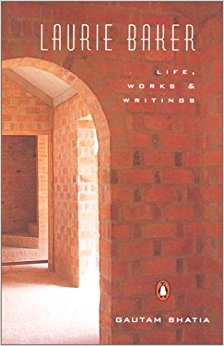
Gautam Bhatia (1991). Laurie Baker: Life, Works and Writing, Penguin Books, pp. 312.


I chanced into this book on Laurie Baker, the delightful British architect who stayed a long part of his life in India, the same way I bumped into one of his own creations- by pure accident. A few years ago, I was eagerly stepping into the grounds of Centre for Development Studies in Trivandrum (southern Kerala) for visiting the library to browse through its delectable collection of books. I was spell bound by the beautiful buildings nestled in the quiet grounds and for a change, preferred staying outdoors to the reading hall.

Laurie Baker stayed in India, first in Pithorogarh district in the valley of Himalayas for sixteen years and then in Kerala. A chance encounter with Mahatma Gandhi at the height of Quit India movement in 1942, led Baker to a maxim that true independence can come only when self-reliance and local craftsmanship was employed in building the nation. Gandhi’s message instantly struck a chord with young Baker since it resonated with his intense religious faith (he was from a Quaker background) and his own professional training.  The bare simplicity of his architecture (constructing only the essentials) and the blunt honesty of his structures (where mud looked like mud and brick, like brick) is a veritable reflection of his realised faith and the harmonious balance between his work and life.

Understanding the vernacular
One of the cardinal principles of the Baker method of building is the appropriateness of traditional methods- using locally available material suited to climatic conditions with locally available skill and technology. For him, originality lay in going back to the origins, the tried and tested method of trial and error, by which people over thousands of years participated in an ever-going research to build enduring, meaningful, cost effective and sustainable buildings. Most of Baker’s architecture is uni-style, using mud, locally made tile and bricks, particularly suited to the tropical climate of Kerala.

In his writings, Baker muses on the centrality and the marginality of the architect. The architect is the primary individual who has to see the problems of construction through to the end, and not fall back upon other ‘structures men’ like the engineer or the carpenter. From the realm of ideas and drawings to the final outcome as a tangible structure, a building results when an architect constantly intervenes and relentlessly controls the process. Yet, in a beautiful contradiction of roles, Baker calls the architect an extra, the side piece, an outsider, who merely realises another individual’s attachment to his place of dwelling, a family’s sense of security and familiarity. This deep involvement in his craft and empathy with his clients makes him a humanist builder.

Problems with modern architecture
Baker is unsurprisingly a critique of modern mass production of buildings at high cost using unsustainable methods. At the turn of the twentieth century, when modernism was setting in, there was a widespread belief that technology would facilitate the arrival of facilities at affordable rates to ordinary people. This was especially true in case of housing with rising demands and shrinking resources. Baker argues that modern movement took a sterile turn for the worse with the industrial economy taking design over. Humanistic considerations no longer remained centre-stage in housing projects. The advent of cement, steel and glass has transformed natural ways of building homes into a purely industrial enterprise.

This break from tradition also implied the coming of the anonymous, impersonal buildings. The need to evolve buildings amidst severe resource constraints and the emphasis on speed tyrannised the creative part of architecture, shifting its focus from earthy humanism to technology. Mass production of building parts by mechanised production has overwhelmed expenses and underperformed at the demand side, literally pushing people to homelessness.

Baker’s method is one of the important and sustainable answers to the housing problem in a country like India. The simultaneous understanding of change and tradition is at the heart of meaningful evolution of building cost-effective homes. Assembly-line approaches cannot grapple with the idea of space, habits of tradition, possibilities of imagination and the unarticulated specification of geographical condition. Baker has built a vocabulary of these elements in each of the thousand buildings he has constructed over five decades in India. His client list includes the iconoclastic individual, the imaginative community and the bureaucratic institutions.

The delightful book is divided into three parts- a commentary on Laurie Baker’s architecture by renowned architect Gautam Bhatia, details of forty select buildings from thousands of Baker’s architectural creations and Baker’s own inimitable writings and speeches, most of which are unpublished. Baker’s writing lucidly brings out his ethos, his methods and vision for housing in India. There is a list of appendices which present Baker’s cost-cutting manual and guidelines to cost effective building strategies. For an architect- academic, a more formal presentation of Baker’s work, authentic photographs, plan layouts and academic referencing would have been of help. But for the lay reader who enjoys architecture, this book is a great introduction to an iconoclastic architect who gave India a lot to cherish for.

Thursday, 11 May 2017

The American Imperative


Colson Whitehead (2016), The Underground Railroad, London: Fleet, pp. 306


‘In America, the quirk was that people were things.’
                                                  
If you are a thing, your value depended on your possibilities. After being appraised and reappraised in the scales of other men’s visions, you knew your value and your place in the order of things. To escape the confines of this hierarchy was to escape the principles of your existence. The Underground Railroad, winner of Pulitzer Prize Fiction 2017, is a daring novel that maps the journey of escape of a slave girl as she traverses the physical terrain and foundational myths of America.

Three generations of slave women- Ajarry, Mabel and Cora- are at the heart of the story. While grandmother Ajarry was sold from Africa and died in plantation after being sold and resold many times over, her only surviving daughter Mabel attempts to escape the plantation and is not seen thereafter. Cora, Mabel’s daughter, is living as a stray, outcast among other slaves. She is part of the Hob that has seven outcast women who have insulated themselves from the insinuations of the world around them because of their reluctance to mix with others. As she is fighting for her ‘three square yards of dirt’ within the plantation where she grows her own garden, she meets Caesar, a former freeman from Virginia, who offers her passage to freedom through the ‘underground railroad’. Cora is compelled to take this offer and she sets off on a dangerous journey to go to the free states up north.

Upending metaphors
In this vicarious pathway to freedom and dignity, Cora encounters different states, each a possibility of an alternative America. In each of these steps, she encounters a terror more unprecedented than the previous. Cora understands that you do not need chains to imprison a person- the purpose of chains was accomplished in so many different ways. The seemingly harmless hospital in South Carolina is a hub of eugenics that subjugates black people through controlled sterilisation and her refuge (a nook in the attic of a white man’s house) in North Carolina is no more than a secret prison. Cora understands that ‘the world could make living prison of your safe haven.’ As she passes through South Carolina, North Carolina, Tennessee and Indiana, a miraculous combination of faith and friendship, takes her to her freedom.

What makes the novel stunning is the way metaphors and myths are turned on their heads, to live out their literal existence. Colson Whitehead sketches the details of the underground railroad by making the metaphor live its meaning, bolts and all. The railroad literally spreads like invisible vein of slave transport, an empire with its own logic, under the foundation of America. From this underbelly, it chisels away at the foundational myths of the American Declaration of Independence- the promise of equality, freedom and dignity to all its citizens. Cora hears of the Declaration recited by a slave and thinks of it as a ghost from the darkness. Later her language tutor Georgina tells her, ‘The Declaration is like a map. You trust that it’s right, but you only know by going out and testing it yourself.’ When Cora ventures out, truth comes to her as a sudden engine from darkness dislocating all her beliefs, breaking her. When she works as an actor in a history museum in South Carolina, playing out a slave for the white audience, she thinks of truth as ‘a changing display in a shop window, manipulated by hands when you weren’t looking, alluring and ever out of reach’. Simple theatre becomes a refuge of faith that comforts her. It is this same mistrust in truth as revealed by history that makes her reject the Bible and poetry.  Cora understands truth, freedom and equality when the lived experience of her life confronts the inherited faith of her society.

Questioning history
The American landscape is portrayed with as much brilliance as the mindscape of its people that run a ruthless machinery of order and hierarchy. The slave master and the slave catcher, the slave mother and the station agent, the grave robber and the abolitionist, are all the products of the same system. The philosophy of the slave catcher Ridgeway sums up the unstoppable racial logic, that the story portrays and disembodies, trenchantly. He believes that the true American Spirit was one ‘that called us from the Old World to the New, to conquer and build and civilize. And destroy what needs to be destroyed. To lift up the lesser races. If not lift up, subjugate, if not subjugate, exterminate. Our destiny by divine prescription- the American Imperative’. Ridgeway worked for this ‘American Imperative’ to ensure that property remained property. It was a notion of order, hierarchy of social arrangement and chain of value.


In the end, this is a story of one woman’s indomitable will to escape her destiny and find her way to freedom. Quite directly, it is her adventure through space and time in America where at each step a unique terror awaits. But this is also a meditation on history, our understanding of our pasts. In this light, the politics that works when black history is placed in the pages of white narratives attacks the foundational myths of the America. This story also brings out how technology moulds history, the tale of inventions and human endeavour to find a way out of difficulties, the kind of technology that is fantastic and adds meaning to life. Whitehead is claiming back something substantive here, but it is not something we are expecting. The novel is in the same vein of other defining works that took the idea of identity and turned it on its head- Julian Barnes’ England, England on the English question, Paul Beatty’s The Sellout on slavery and Howard Jacobson’s The Finkler Question on being Jewish. An important perspective for our times!

Thursday, 6 April 2017

Incurable Life


Atul Gawande (2014) Being Mortal: Medicine and What Matters in the End, Metropolitan Books


Atul Gawande is a medical researcher, surgeon and writer. Like most of the popular writers of science, he is an evocative story teller. He begins all his reflections from the practice of medicine, his vast clinical experience, inevitable questions of his patients and ruthless self examination of what it means to be a sensitive doctor in modern times. His narrative expands with his ambitious canvas, from the microscopic particularities of case studies, to the bigger questions that connect medicine with modern life. As the author of four bestselling books- Complications, Better, The Checklist Manifesto and Being Mortal- the core idea that he has dealt with in all his works, is how revisiting the role of expert can help in serving modern life better. He probes the limitations of his profession, the built-in ambiguities of practicing medicine and the problematic situations that require fine judgment from the practitioner. He is disturbed by the ‘tragic mistakes’ or the experts’ inability to effectively use the knowledge she has, to make better decision outcomes.

The fragility of caring
In Being Mortal, Gawande examines how modern medicine has dealt with old age with evasive unease. Medicine and public healthcare has ‘medicalised’ our existence so much that we treat death as a clinical procedure to be overcome. Serious illness, frailty and approaching death are sequence of a process none of us are immune to. It is at once, about the individual at the heart of the problem as well as about his loved ones waiting in the fringes. It is about dignity and control, choice and decision making when faced with the fear of loss and uncertainty. The autonomy and dignity that an individual has, makes the last days of his life, a kinder and warmer experience for him and his loved ones.

The book has two parts. In the first part, the author examines each available option of assisted living for the elderly and evaluates them. In the second part, he discusses the option of euthanasia and what assisted death has done to the idea of assisted living and palliative care. In his characteristic narrative, the author weaves his arguments with powerful stories, clinical case studies from different countries, personal encounters with patients, friends and family. Our singular concern with health, longevity and safety, he says, devalues the subjective values of what makes life worthwhile in significant ways. Instead of fighting for a prolonged life, Gawande argues for a life imbued with meaning to the individual concerned.

Changing perspective of healthcare
The book calls for a change in our philosophy of heath care and argues that our preoccupation with health should turn to well being. This is especially relevant as traditional societies like India are rapidly moving from joint-family to smaller family units. Care giving as we have known in these societies as a family-centric event is rapidly changing. This shifting perspective also alters the roles and responsibilities of the doctor, from being a mere source of information, to being a partner in shared decision making. The importance of palliative care and involvement of families become part of the solution.

The hard questions that the book raises are important; but there are no easy answers. One problem with Gawande’s style of argumentation is that qualitative case studies bring out the rich detail of individual cases but have to be backed by data to understand larger trends. Secondly, the autonomy of an individual with terminal illness becomes problematic when it is a case of dementia or Alzheimer’s. This aspect is not explored fully in the book. Even then, Gawande succeeds in raising the right questions for us to debate. As he remarks, ‘Arriving at an acceptance of one’s mortality and a clear understanding of the limits and the possibilities of medicine is a process, not an epiphany.’ This is indeed an important book for our times.


Saturday, 18 March 2017

An Unequal Music


T M Krishna (2013), A Southern Music: The Karnatik Story, 
HarperCollins, pp. 588

When TM Krishna speaks of music, it is ‘…the intimate, gentle, profoundly emotional character’ that is central to Carnatic performance. Carnatic music is the form of Indian classical music that has been practiced in southern part of India for more than thousand years.  And TM Krishna himself has been involved in this tradition for more than three decades - as a singer, teacher, researcher, critique and a receiver of music. By analysing musical performance in theoretical frame and historical contexts, the author unravels the evolving tradition of music both as an involved practitioner and as serious researcher. For him, the archives are as wide-ranging as documents, inscriptions, recordings, temple paintings, traditions and conversations with musicians (as bearers of an inheritance passed on from teacher to the student orally through generations).  To him, music is meant as an artist’s way to create time. To him, tradition is when structures cease to be a set of rigid rules; and rather becomes a set of competing orthodoxies, open to experimentation and interpretation. He is irreverent and provocative, deliberately spreading facts before us, asking us to test it in the light of reasonableness. He is in search of the origins and philosophy of music and he goes in a quest to find meaning beyond the visible surface of the concert to the depths of an artist’s heart from where all music springs.

The Intent of Music
One of the central arguments of the book is to look at music beyond technicality to other sources that renders music its musical ‘quality’ at a time when technical prowess is taken as musical genius. Krishna alerts us to the original intent of music and indeed all art forms. The author begins with his definition of aesthetics as going beyond just ‘conditioned comprehension’. He brings out music as both an impersonal sense of experience and as a manifestation of personal feelings and needs. At the beginning of the book, he remarks, ‘There are two types of experiences that art can give us: one is about ourselves, and another is purely about the created.’ Lack of either of these qualities makes the experience of art incomplete.

Then he makes his second observation that the intent of music, especially Carnatic music, has an externally constructed emotional charge called ‘social intent’ as well as the deeply intimate ‘personal intent’. This social intent of music has been the source of inequality- of gender, caste, class- that has systematically barricaded majority of the people from being the receivers of this musical form. Krishna  also openly criticises the reluctance of practitioners to introspect about the unequal acknowledgement of other artists based on their caste and gender identities that reinforces their art as lesser music. Krishna’s social critique of Carnatic music also needs to be seen in the musical projects that he is involved in- to take Carnatic music out of the pristine halls of concert to the wide-open spaces of streets and public spaces in and around the southern Indian city of Chennai.

One way Krishna attempts to bring change is to alert the performer to his role in relation to the composer and his texts. The performer interacts and interprets the composer throughout the rendering of music, being his contemporary partner yet retaining his autonomy. Krishna compares the expectation and defined role of the western music performer and a Carnatic musician. He highlights the responsibilities of the performer to his composer and his intentions, to the historical context of his piece (that sometimes relegates music originally rendered by women or those having erotic content as secondary to other compositions), to his fellow performers of various musical instruments and the receivers of music that includes the performer himself. Krishna also alerts us to the ever-changing landscape of music that is changed by evolving traditions, method of sponsorship and training, technology and new research that brings out various streams that erupted from the vast tradition that we simplify as Indian classical music.


Towards a more equal music

This book has twenty-seven essays, all of it eminently readable. In this book, there are questions for everyone - a scholar of Carnatic music, to a sensitive practitioner as well as a discerning enthusiast. The language is conversational - indeed you are in the presence of a serious scholar, committed musician and a witty companion. His arguments are well backed with evidence, his humour is self-deprecating, his frankness disarming. There are parts of the book on the philosophy and social returns of music that speaks to a universal audience. You may read select part of this work and still take home something new and refreshingly radical. What you cannot miss is the place where Krishna’s music and his musical intent come from- this book is a journey with one of the finest practitioners of Indian classical music, whose heart goes beyond performance to the politics and sociology of his art.  He stands as a rebel trying to democratise tradition, introspect on his inheritance and attempts to widen the various streams that enrich the music he is a part of. To that end- to bring a more inclusive music- he looks at the ideas of beauty, philosophy and aesthetics. To work toward a more equal music, he searches the heart of our society and the people for who all art is created. 

Wednesday, 1 March 2017

The ‘Prose’ and Cons of Being a Poet

Maps for a Mortal Moon (Aleph) &
 I Dreamt a Horse Fell from the Sky (Hachette) 
Adil Jussawalla


No one can write about one book of the Indian poet Adil Jussawalla.  One must present a bunch of his collected works, both fiction and non-fiction like a bouquet of flowers. Only as assortment of melodies, this music makes sense. The reader must experience the world of Jussawalla as a wholesome experience of entertainment and alienation from comfort zones. You are in the presence of a nomad who is addicted to deracination, an architect who shapes poetry, a critic who births new languages and a wit who unwittingly is making and unmaking norms.

The two books that collect his fiction and non-fiction work in two very different ways equally well- as a one-stop preview for the uninitiated to get a taste of Jussawalla’s intense, dramatic and poignant world that begins and ends in South Mumbai (but traverses many worlds in between) and as a reflective piece for those who have followed him through his productive decades. Jussawalla’s essays on people, artists and writers, art works and literature, places and travelling document with tenderness and unfailing wit, what is erasure in this world that is adept in losing important things. Indeed, the able editor of Maps for a Mortal Moon, Jerry Pinto (author of a fine novel Em & the Big Hoom), remarks drily that the Adil Jussawalla has spent the best part of his life battling amnesia that results from things, people and landmarks disappearing. His essays are a collection of things fast receding, treasures that we should have held close to ourselves. What us poignant is that he displayed a unique penchant to collect some of these things from the verge of disappearance. Anecdotes have it that in his paper-lined flat in Cuffe Parade, Mumbai, some of the finest poets writing in English (Jeet Thayil, Eunice de Souza) would have their scribbled poetry collected, kept and published in anthologies later. In this sense, Adil was literally a keeper of literary conscience.

The most enduring contributions of Jussawalla however, were in the capacity of editor, teacher and a publisher. He had tenure at the national newspaper Indian Express where poets like Arvind Mehrotra were given two full broadsheets for book reviews and later in Debonair. As a teacher of literature at St Xavier’s College, Mumbai, he held poetry reading called Dangerous Animals every Tuesday. As a founding member of poets co-operative Clearing House, he was setting up a modest but important clearing house for poetry manuscripts of the 1970s. Regrettably, in India today, we have only small publishers interested in discovering poets as big publishing houses are led by supra-literary concerns while selecting manuscripts.


From the vast expanse of his world to his intense scrutiny of the here and now is unsettling. Reading his poetry (The Right Kind of Dog & Trying to Say Goodbye) brings discomfort- he places the most disparate things close to one another, distorting expectations and creating strange experiences. His poems begin at the fissures of this disjunctive unsettling, it has many registers each resembling the many worlds of the poet and his many variations of a self over the years. For the deeply compassionate and engaging conversation with Adil Jussawalla, these edited works provide a good introduction.

Friday, 3 February 2017

The Kingdom of Queens

Manu S. Pillai (2015). The Ivory Throne: Chronicles of the House of Travancore, HarperCollins India, p.694


Chronicling the history of Travancore as it was a kingdom once and then a princely state in British India is no mean task, especially for a first time writer. Manu S. Pillai, the daring debutant, has accomplished such feat with natural felicity! Nearly seven hundred years of history of a small kingdom in southern India is unique not just because of its natural beauty or famed riches, but also because of its dramatis personae- the matriarchs of royalty. In retelling a story of ascent to power, women’s inheritance in family, war and palace coup, this book is riveting.

Pillai uses a rich array of historical documents, private papers and in-person interviews to reconstruct the story. He deftly balances out the famous incidents and anticipated characters with the rare and unheard-of incidents. For instance, the painter prince Ravi Varma makes a theatrical entrance and so do the well known maharajahs and dewans of commendable exploits like Marthanda Varma and Velu Thampi Dalawa. But in the broad brush narrative, the author does not lose the richness of details that personal eccentricities and social circumstances that gave birth to momentous events. We encounter the shrewd regent queens who govern ably surviving court intrigue and later come out as king-makers. No stone is left unturned to build the future of Travancore- the human, the divine and the abhorrent (black magic and sorcery) are in command to lay the foundations of its destiny.

In a book that follows the destiny of royalty and their princely state, rivalry and scandals are inevitable. But the best part of the book is the space given to a nuanced understanding of the social history of policies of reform. Land laws, health and education policies, equal opportunity and modernisation were ushered in Travancore through gradual and consistent investment in public policy. The priorities and personal weakness of its rulers and regents were sometimes obstructive to development and their obstinacy and nepotism deleterious; but the history of Travancore seemed to have a life that was vitalised by its social movements and democratic participation of its people. The temple entry proclamation to people of all castes, land reform, opening of education and employment to qualified individuals and movement for women’s emancipation require special mention for the way they have been built into the narrative. It is in echoing the other voice, that of the people, that the story of its rulers remain complete and coherent.

Historical narratives of the princely states that made up modern Kerala in accessible narrations in English are rare and this book fills that much needed gap. A magnificent effort for a first book!


Friday, 13 January 2017

Delhi and the Dark Arts


Elizabeth Chatterjee (2013) 

Delhi Mostly Harmless: One Woman’s Vision 
of the City 

Random House India, pp. 283


I began the year reading Liz Chatterjee’s portrait of Delhi based on the one year she spent collecting data as a doctoral student of the University of Oxford. There are many portraits of modern Delhi, beginning with the elegy written evocatively for the older courtly Delhi in 1940 (Twilight in Delhi by Ahmad Ali), to the modern project in the making that Delhi has become in the recent decades penned by academics (Unsettling Memories by anthropologist Emma Tarlo). My personal favourite books are those by that incorrigible breed of Flâneurs (City of Djinns by William Dalrymple) and novelists (Midnight’s Children and The White Tiger). There is also the attempt to know Delhi through its people (Capital by Rana Dasgupta) or visuals (Delhi: The Making of the City by Malavika Singh and Rudrangshu Mukherjee).

Liz Chatterjee is part flâneur and part anthropologist. Her memory of the city, its people, and its stories come out not in anecdotes or metaphors but as disjointed parts of a person. She literally senses the city around her and her chapters are arranged in anatomical terms- eyes, noses, hearts, veins and so on. And sometimes she gropes the pragmatic old lady Dilli followed by rubbing shoulders off the new city of Delhi. The savvy that carries an Indian along, part oblivious and part accommodative to the paradoxes and contradictions of any part of India she resides in-with  boisterous openness to outsiders and cold conservatism that builds hierarchy, the invisible ropes of high morals and low traps of indignity, can be mind boggling.

The usual dilemmas of finding a safe perch, making friends, settling into a routine in a new city is there; but what makes Liz’s story poignant is the solitude of a researcher, a foreigner, a non-Delhite- who is both an insider and outsider to the story. Liz is an enterprising raconteur and this comes out best in her uncanny ability to get her analysis right- she calls jugaad, the dark art that requires ingenuity to fix things, to have savoir-faire and not such technical skills. She is blunt and direct when describing the hundred indignities a woman goes through in private and public space, some very specific to the city. Through every difficult experience, what remains intact is her sense of humour.

What make her book delightful are those parts where she tries to preserve the experience of being with someone who is hardly likeable. She uses her sense of olfaction to store a million things that is worth a thousand words or photographs of the city she has lived in for a year. In one of my favourite parts of the book, she says, of the faint coconut oil that scents a woman’s hair, to the stink of stolen cigarettes, the mixture of sweat and cheap cologne and names a number of such things that made this story her own, ending with the glorious fragrance of burnt flat in the first rain of the season. Then she finds the right words for such a nose for nostalgia- manvasanai in Tamil and petrichor in English for describing the Greeks God’s blood through the veins of rock.


And in the end, she concludes, ‘Delhi, the delirious city, city of the tense present, future imperfect’. Comparing her across the globe, New York  may be a wise guy, Paris a coquette, Rome a gigolo, Berlin a wicked uncle and London an old lady- Delhi looks like an ageing Tsarina- ruthless, capricious, avaricious, paranoid and like all grandes dames, jingles with theatricality, bling and the so –bad-it’s-good.  At the same time, the modern city of Delhi, built for rulers and administrators,   is a sophisticated cougar, modelling herself to the twenty first century with overconfidence and attempts at self assertion of an adolescent. This duality of a theatrical old-hand who has witnessed human history and a restless adolescent trying to seek attention and assert her presence, makes the city difficult to like or understand but hard to ignore.

Tuesday, 27 December 2016

The Grim (Humour) that Stole this Christmas


The Sellout, Paul Beatty, OneWorld, pp. 289


The grim humour that stole this Christmas for me is Paul Beatty’s The Sellout. The first novel by an American author to win the Man Booker Prize, the book is a biting satire on race relations in a country that has just seen the end of an African American Presidency.  And it is in questioning these large symbolic breakthroughs in ameliorating the everyday lives of any group that is not mainstream that the book does unabashedly. The collective resistance under the leadership of Dr Martin Luther King, the rejuvenation set out by Harlem renaissance, the historic Presidency of Barack Obama are taken as one off events and questioned on both intrinsic and relative merits on the community they sought to better and ended up leaving worse off.

‘I whispered racism in a post-racist world’, says the protagonist, who is an African American tried in the Supreme Court for owning a slave and practising racial segregation. Indeed our protagonist is a product of experimentation from childhood and bears its brunt with an equanimity that accepts reality and attempts to change it by using its own logic. He makes it through his childhood home schooled and generously experimented upon by his father a behavioural psychologist. In this process he becomes an object and this experience of total isolation from agency exists in him with fierce bouts of resistance. He loses his family, his neighbourhood disappears from the maps and minds of the administration and he is left hanging listlessly with his friends in a no man’s land. From this window incognito, he strikes back using the very instruments that made him suffer. He makes the entire society flinch by unleashing the same kind of experiments back on them.

Of this novel, I can say the journey is the message. The language with its endless puns, metaphors and slang is abrasive and uncompromising. On writing this book, Beatty remarked, ‘It was hard for me to write, it’s a hard book to read.’ There is savage wit ripping off every holy cow, blurring the sacred, eviscerating the sacrosanct, lampooning nuance leaving us with just the heart of the problem. But then, Beatty trenchantly puts it in his novel, ‘being offended is not an emotion.’ Parts of the book make us laugh, then cringe and in many significant ways reflect the times we live in.

This book was turned down eighteen times by established publishers before being accepted by a small two people publishing company in Scotland called Oneworld. It is also the publisher’s second Booker in a row after last year’s winning novel ‘A brief history of seven killings’.  As far as the Man Booker prize goes, satire barely makes it as favourite. Yet, out of the 155 books that entered the prize this year, The Sellout was the unanimous choice of the jury and is a great work of fiction comparable to the tradition of Jonathan Swift and Mark Twain.


Saturday, 12 November 2016

The Renegade Apostle


Amos Oz (author)/ Nicholas de Lange (translator), Judas, 2016


There are two stories here, both of them, timeless and tender. In the fringe of Jerusalem in harsh winter, Shmuel lives a contented life, going about his graduate studies at the University, political activism with like-minded friends and a tender longing for the woman in his life. The quiet of his commonplace life is suddenly disrupted and he is compelled to be the conversation companion to the aging and argumentative Gershom Wald. In the closed confines of that mysterious house, he meets the enigmatic Atalia. The avid Zionist in Wald and the mysterious Atalia open to him a world of new possibilities.

Shmuel’s enquiry into the character of Judas, the traitor of the son of God, ends in his assessment that Judas may not be the renegade apostle, but an ardent believer whose immutable faith leads to his own tragedy and his teacher’s. More than anyone, Judas was awaiting the ultimate miracle from his master, the return from death, even as Jesus questions himself relentlessly. It is with Jesus on the Cross, irreversibly lost to the world, that Judas comes to terms with the complete breakdown of his faith and the fatality of his persuasion. With the core of his belief shaken, the only possible way out is death.

By traversing with the beliefs of Judas, we are travelling through one of the most sought after and abused road of treachery and betrayal that has simmered in medieval Europe between Judaism and Christianity. What is the most inventive part of the book is Shealtiel Abravanel, the only man who opposed the Zionist project as the modern apostate equivalent of Judas. Traversing through the veins of old Jerusalem of Jesus and Judas, Shmuel unwittingly also crosses the dreams and destiny of the sparring friends Wald and Abravanel, insider and outsider, believer and traitor, Zionist and apostate in a war of ideas about truth, faith and mercy.


One of the boldest novels from a perpetual favourite for the highest honour in Literature, the Nobel Prize, Amos Oz does it again long after his magnum opus ‘A Tale of Love and Darkness’ and does it with the panache of a master storyteller. His is a vision that brings together the proximity of diametrically opposite notions of trust and betrayal, love and hate, the safe confines of lost inheritance to the words and ideas of our times. And in doing so, how tender the strength of our views looks in the eyes of the other and how the certainty of our justices shudders in the pain on the other side! Truth, ever so fragmented, lies in so many voices on both sides of the transgression.